 On the final day of our four days touring in Hokkaido, it had been raining insistently from the early morning. We had been wondering inside the lodge about where we should have a good time before boarding an airplane back to Tokyo departing Asahikawa airport at 19:35 pm.
As we had not expected that it would rain, it took us some time, looking at the maps and discussing on several options for a considerable time, until we finally decided to drive south back to Furano to taste delicious local cheese and pizza at the Furano Cheese Factory. From our lodge in Higashi-kagura forest near Asahikawa city, we drove through the country roads in the autumn gentle rain dripping to reach the site for just one and a half hour.

It was a pleasant and quite place. They produce 5 different kinds of original cheeses including the wine cheddar co-developed with Rakunou Gakuen University in 1982, as well as various dairy products such as Nailao ("奶酪"), an old Chinese court sweet, all which we can buy at its souvenir shop. Visitors can also observe the cheese making process. At lunch we ate the big genuine Neapolitan pizzas with full use of its original mozzarella cheese and local fresh products baked on the firewood cooking stove that they imported from Nepali, where the chief chef learned making pizza process. I was surprised to see that my ladies, my wife and the elder son's wife, not satisfied enough, further insisted to taste its original fresh ice-creams too, as I know they are always cautious not to be fat.

Last October 2014, just one month after my lonely Oregon touring, I traveled Hokkaido, northern main island of Japan, this time together with my wife and my eldest son’s family. They have a kid of less than two years. My wife usually prefers to relax herself at home, not interested so much in holidays getaway. Furthermore she does not have much trust in me when it comes to driving, although she has no driver’s license herself. But when I returned from Oregon, US, she unexpectedly proposed to travel to Hokkaido if we could make a driving tour together with our grandson.
We took an early flight for Chitose airport, which departed Haneda at 6:25 in the morning. After landing, we rushed into a rent-a-car shop and started the four days tour; for the 1st day from Chitose to Sapporo thru Lake Shikotsu , on the 2nd day we drove through Furano to Asahikawa, and on the 3rd and 4th days we had based on a country-style lodge in Higashi-Kagura Forest,visiting Asahiyama zoo and Furano Cheese factory.
Mt. Asahi-dake
 For me Mt. Asahi-dake was the most memorable site. More than 40 years ago when I was a university student, I was heading to this mountain, as a final destination, with my trekking club friends. We were traversing the Daisetsu Mountain Range lying in the center of Hokkaido from Mt. Tokachi-dake through Mt. Tomuraushi. We had a small accident in boiling water for a morning meal in the tent, which injured our friend's leg seriously so that we gave up to continue the trekking just before reaching to Mt. Asahi-dake. Mt. Tomuraushi, among others, has been my most favorite mountain in Japan since then, so grandiose, quite, and beautiful with full of alpine plants. We needed to be only cautious not to surprise the local inhabitants of big brown bears with a weight of more than 300 kg. But I have been wondering how Mt. Asahi-dake, the highest in the range, looks like which we had missed to meet at that time.
Now 40 years later, I rode up on tramway to Sugatami Pond station with my family. We did not climb to the top of the mountain, the highest in the region with 2,291 meters above sea level. It was still covered with ever lasting snow and presented itself really awesome. I thought it deserved to be called a tycoon of Daisetsu Mountain Range, which literally means “the Big Snow Mountains”.
The South and North domes
Tokyo vs Amsterdam station building
More than ten years earlier before Tatsuno began to tackle the design of Tokyo station, Amsterdam Central Station was opened to the public in 1889. A guide book describes the architecture of this red-brick building with a magnificent facade as Neo-Renaissance style full of Gothic characteristics. This architectural expression reminds me of that of Tokyo station. I know nothing about architectural matters, but experts rejected the idea that Tatsuno was influenced by this preceding monument in his design of Tokyo station. To me the Amsterdam looks more majestic with a facade guarded by the two tall and rectangular turrets like in a palace, while Tokyo station gives me a kind of more modest atmosphere with the two octagonal domes in the South and North wings like in a church. It seems to me that Tatsuno had tried to harmonize a western Renaissance style with the traditional Japanese aesthetic appreciation.

Interior of Octagonal domes
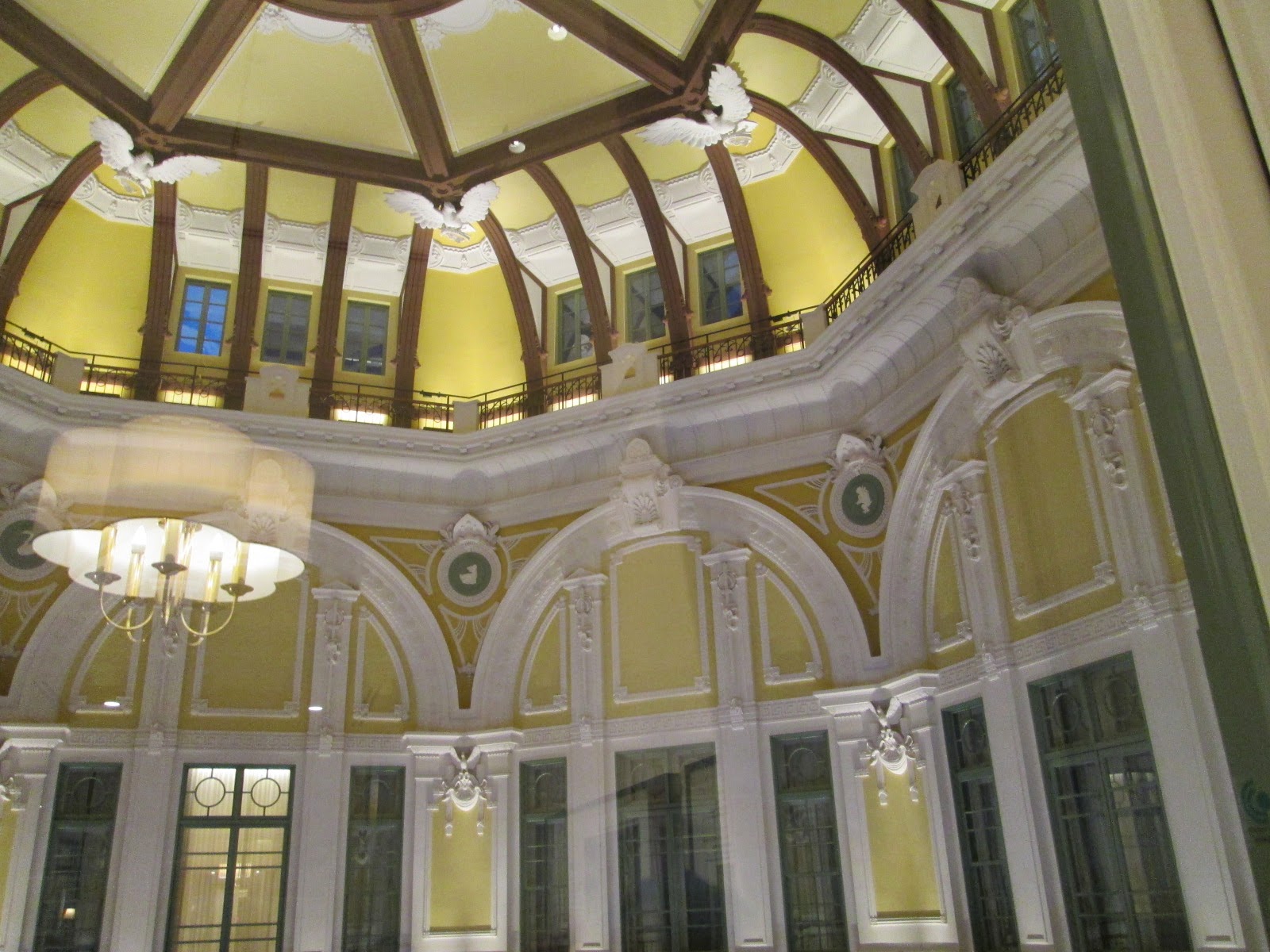
Now we walk into these two octagonal domes capping the modest three stories building. These domes, which had been patched up with the damaged third floor cut down to the two stories building by the postwar reconstruction work, were restored to the Tatsuno’s original design in 2012 through the five years preservation and renovation project. The exterior of doom roofs and its interior space above the third floor were completely renovated. The interior of each dome is ornamented identically. At the vaulted ceiling inside of the dome, we will notice eight eagles positioned in the octagonal corners and also eight zodiac sign sculptures arranged on the dome’s wall according to the directions. The missing four zodiac animals are Rat (north), Rabbit (east), Horse (south), and Rooster (west). Interestingly these four missing reliefs of zodiac animals were found more recently on the four corners of the ceilings of another Tatsuno's building which he designed for his home Saga prefecture after Tokyo station. There are other interesting ornaments like keystone of samurai warrior’s helmet and Relief of flowers or sword found on the ceiling through the wall of third floor.
Tokyo station hotel
The hotel has been residing in Tokyo station Marunouchi building for a century. It began business in 1915, just the next year after the opening of station and had been also renovated during 2007 - 2012. Last November I had a privilege thanks to my friend to make a tour inside this hotel, seeing a luxurious banquet hall and the most expensive Royal Suite on the third floor featuring an awesome view of the Imperial Palace. It preserves classical decencies with relaxing atmosphere as well as various conveniences required to a modern accommodation. The Japanese Novel prize awarded novelist Yasunari Kawabata is known for his frequent stay in this hotel to write a novel.

A city becomes more and more modernized in this rapid world with commercial buildings competing its height with each other to look down smaller pedestrians walking on streets, and people want more convenience and speed in the capitalized economy with faster bullet trains taking us to a once remote place in a shorter time. But sometimes we want to indulge ourselves in a nostalgic landscape and think about our past quietly. Tokyo station Marunouchi-side seems to symbolize the people's desire to preserve and harmonize the old culture with the modern technological requirements.
(The End of "Tokyo station celebrates the 100th anniversary".)
History of Tokyo Station
Central station initiative (1889 - )
Tokyo station was first called “the Central station” around the time when the Tokyo governor issued the order in 1889 to construct an elevated city railway line to connect Shinbashi with Ueno terminal and establish a central station in the middle between them. Shinbashi station was the gateway to the western parts of Japan, Osaka and Kyoto through Tokaido-line, while Ueno was the starting point for Tohoku region, the northern part of Japan.
In early stage of construction (1890 – 1905)
In its early stage of construction, the two German engineers, Hermann Rumshottel and Franz Baltzer, were involved in the initial survey and designed the basic layout of the building. But the central station initiative had not progressed significantly because of the two wars that broke out between Japan and China, the Sino-Japanese War in 1894-5 and then Russia, the Russo-Japanese War in 1904-5. After the two wars, people came to realize more of the importance of railway transportation to develop national prosperity and military strength. Sinpei Goto, the then Cabinet minister of Transport, was especially enthusiastic about building the most magnificent station which would astonish the world, thus letting them aware of the industrialized Japan, which had defeated both Russia and China in the wars.
Tatsuno’s Architectural style (1903 – 1908)
The design of the Marunouchi building of Tokyo station was entrusted to Professor Kingo Tatsuno of Tokyo University in 1903, who was recognized as a pioneer of Japanese modern architecture. He studied architecture as a first-generation student of the Imperial College of Engineering under the British architect Josiah Conder and later at the University of London. His style is said to have been influenced by the Victorian style of Britain in the late 19th century. He designed a red-brick building with an iron frame characterized by granite stone stripes and the two domes that capped a three stories building in Renaissance architectural style, based on the layout plan drawn by Baltzer. Although the bricklaying architecture had prevailed in Europe, he chose to reinforce a brick building with an iron frame, considering a frequent occurrence of earthquakes in Japan. His solid architecture proved its robustness at the Great Kanto Earthquake of magnitude 7.9 in 1923 and no passengers were injured.


Opening of Tokyo station (1908 – 1914)
The construction of the Central Station finally began on March 25, 1908. It took around 6 years to complete the construction and it opened business on Dec.20, 1914. And it was officially renamed as Tokyo Station to symbolize the station at the capital of growing Japan.
Restoration of Tokyo station (2007 - 2012)
Although Marunouchi building of the station survived the Great Kanto Earthquake, it could not escape from the massive US air raids in 1945 during the second world war, with its roof and interiors all burnt down. After the war it was reconstructed as a two-stories building. In 2007 the new project had kicked off to restore Marunouchi building to its original state as our important cultural asset. The construction consisted of mainly three parts;
- to restore the exterior wall for the third floor
- to preserve the brick building frames on the 1st and 2nd floors
- to construct newly the 1st and 2nd basements
The exterior wall were redressed with the face bricks that were specially fabricated to make its appearance closer to the original ones, while the interior of South and North Domes adopted a combination of the original and new design depending on each part. A new base-isolating device has been installed to make the building more resistant to bigger earthquakes. The renovation project took five and a half years with about 50 billion yen ( $430M) invested.

(to be continued)
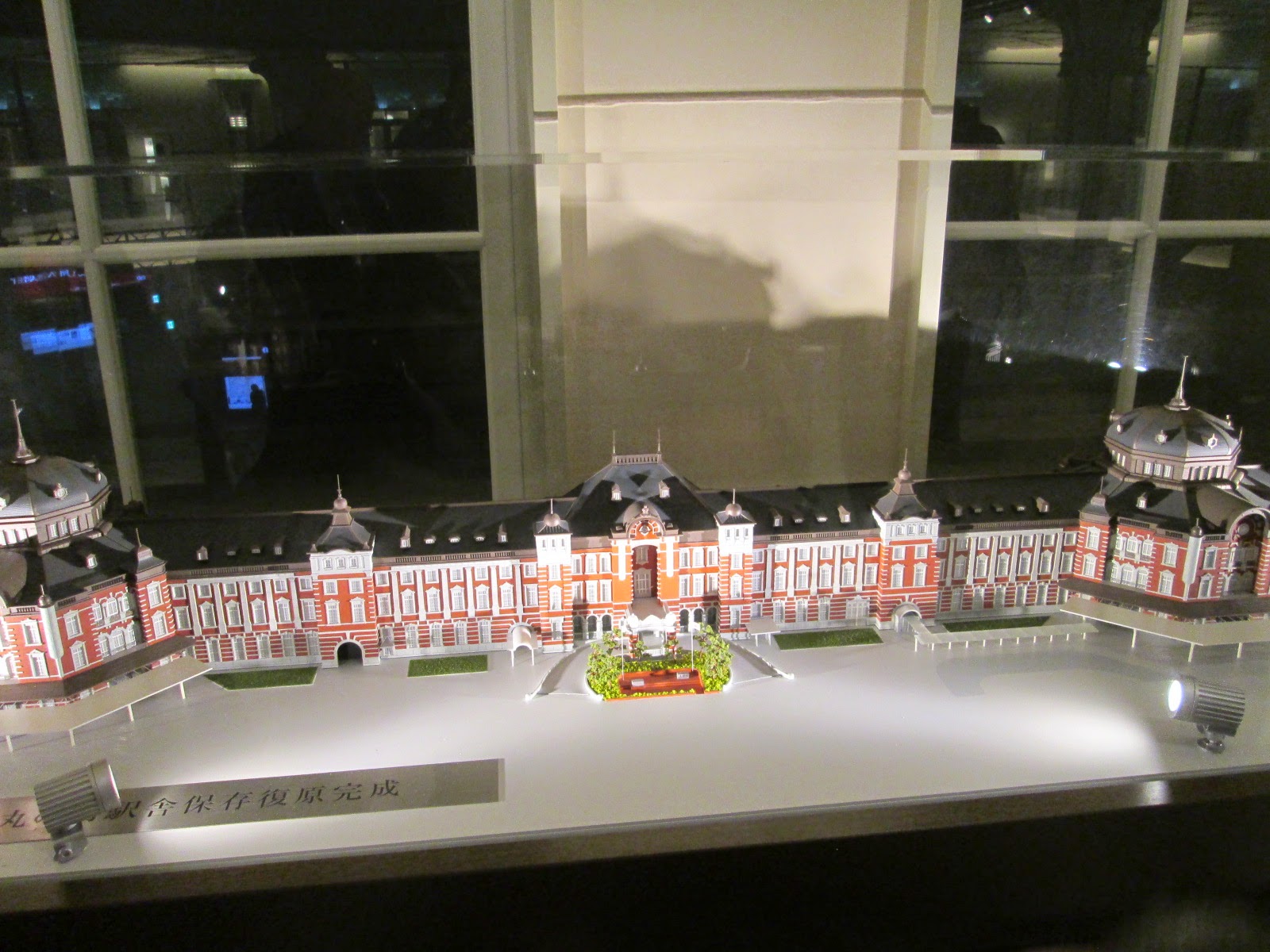
Tokyo station is situated at the heart of capital Tokyo with its Marunouchi-side leading to the carriage-drive way for the Imperial Palace, formerly known as “Edo castle”. The restored red-brick building on the Marunouchi side of the station is around 35 meters high with modest three stories above and two under the ground, stretching 335 meters along a north-south axis. With more than 4,000 trains coming and going every day, there are 14 railroad lines originating at Tokyo station, including the Tokaido and Tohoku Shinkansen Bullet Trains. From here you can go almost anywhere in Japan as you want.

The station also provides tourists with the preserved classical style hotel which can accommodate 150 guests and with the huge shopping mall of total 220 shops on its 1st floor and basements, including many take-outs which sell about 170 of varieties of “Eki-ben” coming from various parts of Japan for your lunch, dinner or breakfast on your train seat.

But that's not all that it has to offer. Before you rush through a ticket gate for a platform, take a glance up, for example, to the ceiling of the South Dome at Marunouchi-side. You will notice its unique cathedral-like dome look of octagonal shape, which was designed by the first Japanese architecture, Dr. Kingo Tatsuno, a century ago. One of his masterpiece, Tokyo station building was burnt down by the U.S. air force raid during the world war 2, but in 2012 it was restored to its original style after a five-year renovation effort. The building is not just a convenient and modernized facility for transportation, but it also presents itself as an historical monument which remind us of the old Meiji era's spirit when Japanese had kicked off toward the modernization after 300 years national seclusion.
 On Dec.20 2014 last Saturday, Tokyo station celebrated the 100th anniversary of the opening. The station was so crowded and I saw a lot of people flocking to buy various items as souvenirs like the specially designed Suica prepaid IC cards to commemorate this event. I'm completely indifferent toward such souvenirs, but in a sense it shows that many people love and be proud of this historical building. I felt like exploring more about this historic and cultural heritage of Japan, which stands with dignity amid a bunch of tall contemporary commercial buildings surrounding it.
(to be continued)
While those ancient Sicachi-Alyan artists had been carving their imaginary creation on the rocks along Amur between 12,000 B.C. and 500 B.C., the ancient inhabitants in Japan were making the so-called "cord-marked" potteries with the decoration of impressing cords into the surface of wet clay. This entire period is called as Jomon which literally means "cord-marked" in Japanese. Was there any intercourse between the two ancient neighboring people? And could we prove it in a scientific manner or by identifying some similarity in their cultural archaeological remains?
Prehistoric culture in Japan
The Jomon culture in Japan is classified as Neolithic and divided into five phases. The earliest phase of this culture developed in Hokkaido and Tohoku, the northern parts of Japan, which is considered to have begun about 12,000 B.C. when Japan was linked to continental Asia as a narrow peninsula. Some scholars believe that the early Jomon culture was brought from Siberia via Sakhalin and the people of this culture were the ancestors of the present-day Ainu. If so, the ancient culture of Sycati-Alyan could have been carried in some extent to the Japanese Archipelago by them. Could we recognize any similarity between the various design patterns found on Sikachi-Alyan's rock carvings and those of Ainu or Jomon people in Japan? This is a mystery.
Jomon Pottery
Jomon pots are the oldest ones in the world. Pottery was first invented by hunter-gathers living in Japan, China and Korea during the last Ice Age about 14,000 years ago. Take a look at some photographs of Jomon potteries with seemingly snake or vortex designs, which I found on Internet although their exact creation dates were not specified. Is it possible to connect these design patterns with those found in Sycachi-Alyan petroglyphs from the artistic view?

The late Prof. Hourai of National Institute of Genetics, who happened to be my senior at the mountain trekking club in the university, had sought for the root of Japanese by analyzing mitochondrial DNA. He claimed that;
- the contemporary Japanese are of mixed Jomon and Yayoi parentage.
- the Yayoi people came from the mainland China through the Korean Peninsula during the periods from 300 BC to 300 AC.
- the Jomon people came from the north in the Jomon era, the time dated back to Prehistoric Japan from 14,500 BC to 300 BC, when the Japanese Archipelago was connected to the Eurasian continent.
I also find the interesting description on the web site by the NPO "Amur Region Historical Heritage Fund". It suggests that there existed some cultural contacts between the inhabitants of the lower Amur and Ains' ancestor in pre-historic era. Let me cite this below;
"In ancient times there were contacts between the culture carriers of the Amur river, Ains' ancestors and tribes of Indonesia and Polynesia. A witness of such links is a wide spread of the vortex ornament, that has the Snake cult as a basis. Presumably, this was further spread out and in remote Australia and Vietnam. The culture of the Lower Amur neolithic tribes is strongly expressed in the Sycachi-Alyan rock drawings and, most likely, had the influence far bound the frontier of this region."
It's a nice experience for us to realize how we've come a long way.
References;
(1) The web site of "Amur Region Historical Heritage Fund"
(2) "Down The Amur from Khabarovsk to Nikolaeusk-na-Amure"
(3) "Ancient Art of the Amur Region - Rock Drawings Sculpture Pottery"
by Alexei Okladnikov
(4) "Jomon period" from Wikipedia
(The End of this series "Rock artists in Sycachi-Alyan, 12 Millenniums ago ".)
To know more about Sikachi-Alyan, I made my way
to the Far Eastern State Research Library on Muraviev-Amurskiy street near the museum. It was the old red-brick building of early 1900s. On the left to this library, there stands the Holy Assumption Cathedral Church, Uspensky church in Sobornaya (Cathedral) Square, which is one of the largest Russian Orthodox cathedrals in the Russian Far East. From the Cathedral square people can descend to the the bank of great Amur river. This is the one of the most spectacular viewpoint of the river. Unfortunately, as the river was still flooded, there were no excursion ship in operation for tourists.

 The Library looked a little bit majestic. But as I entered into the building on Sunday afternoon, I saw an old woman sitting on the reception desk. She was kind enough to take the trouble to issue a permission card to let me in, although I was absolutely a stranger from an Asian country and her English was as terrible as my Russian. Here I found interesting legends related to Sycachi-Alyan in the book titled "Down The Amur from Khabarovsk to Nikolaeusk-na-Amure"
Legend in stones
Some long time ago in the location of the present-day Sycachi-Alyan a small nomadic camp existed. Its inhabitants led a quiet life but once misfortune came. The volcano awoke and burst out the fiery lava that in an instant destroyed the small camp and everything alive around it. Only two persons got saved, a husband and wife who had gone hunting across the mountains. Upon coming back home they saw a terrible picture. The land was covered with ashes and there was nobody alive around. For several days they shouted and cried in distress until losing voice. In the meantime the earth got cool and started looking like a choke-cherry cake. And the stones of the Amur river bank were still soft. The husband and wife strolled along the river drawing on the stones by finger. They wanted to leave memory of the perished and the native camp. The local inhabitants believe that these people who avoided death were the predecessors of the Nanai nationality.
Legend of the three suns
In Sikachi-Alyan they will tell you the legend of the three suns:
"... Many centuries ago things were different. We had many animals in the taiga, much fish in the rivers, and forests were rich in berries, nuts and medicinal herbs. But once three suns were seen in the sky and they burnt the earth so it grew black, the trees and herbs got extinguished. The heat was so strong that the birds' wings were broken. They say then ravens appeared among birds. The people trying to find refuge from the three suns excavated deep dugouts where they stayed till late at night daring to come out only in the evening to see the horrible picture: burnt earth and dead fish in the river. The people began praying to the God of the Earth - Dragon Kailasu felt sympathetic and sent his twin sons Ado. The brave warriors took sharp arrows and shot two of the suns that rolled down to the underground world so order reigned on earth again. And the twin brothers became gods since then and the people called them Ado-seveni ..."
The plot of these two legends today can be seen in the art of the local painters and craftsmen, in the bright choreography of the folk lore ensemble Aioga and of the Ethnographic Museum exhibits.
(to be continued)


