On the way to Dobbiaco in Sesto Dolomites
One of the highlights in my Dolomite trekking was Tre Cime di Lavaredo in the Tre Cime National park (Three Peaks Nature Park) in the Sesto Dolomites of South Tyrol, surrounded by Dobbiaco, San Candido and Sesto. So, I decided to base on Dobbiaco or Toblach in German, a small country town located 10 km south to the border with Austria.

While planning in Japan, I wondered which route by bus or train would be a more time-saving and pleasant journey from Venezia to Dobbiaco. After checking the various information on Internet, I choose the bus route. In Japan, trains are much secured transportation than buses in general, but it is a different story in Italy, especially in the case that one needs to get on European cross-border trains. I was right with this choice, because in return I had a terrible experience with the Italian train services.
On July 1st, I got on the ATVO shuttle bus at Piazzale Roma which departed at 7:50 directly going for Cortina d’Ampezzo. It arrived there at 10:35 am just in time, but the weather suddenly deteriorated with a fierce sleet. So I decided to wait for the next bus at the café shop within the bus station building together with a young solo climber from Japan who happened to take the same bus from Venezia. He was, unlike me, a professional climber belonging to the Japanese Alpine Club and going to stay at the mountain lodge in Tre Cime on that day. We enjoyed chatting over local wines, in which he had special interest.
 The local bus arrived at Dobbiaco at around 14:00, a little bit behind schedule. Casa Alpina Dobbiaco, my basement here for 5 days stood just in front of the last bus stop. At dinner I was entertained much with local dishes and wine.
 Lago di Braies
On the next day, I was joined by my old friend who had happened to be in Germany on business trip. After I welcomed him at the Dobbiaco train station and brought him to the hotel, we together headed for the lake Braies by bus. It took us less than 30 minutes to reach there. The lake is situated at the height of 1493m above sea level, surrounded on three sides by rocky walls made of grey dolomites of peaks including the Croda del Becco (2,810m).


We enjoyed a stroll for about 2 hours around this blue mysterious mountain lake with a length of 1.2 km and a width of 300-400 meters. We wrapped up the day with beers at the hotel’s garden facing the lake. Later I found this hotel was well known for the Nazi holding 141 high-ranking politicians and officials here as a hostage during the world war 2.
Tre Cime di Lavaredo
The Dolomites, sometimes called as the Italian Alps, are located in the northeastern part of Italy close to the border with Austria. They form the Southern Limestone Alps which extend from Switzerland, Austria to Slovenia. The iconic landmark of the The Three Peaks Nature Park in the Sesto Dolomites are the Tre Cime di Lavaredo or Three Peaks of Lavaredo (2,999 m), characterized by the bizarre rock formations, part of the Unesco World Natural Heritage site of Dolomites. The Cima Grande, the highest of the 3 pinnacles, was first conquered in 1869 summer. Since then, alpinists from all over the world have come here seeking for great adventures.
That's why I chose the hiking around the Tre Cime as the top priority of my travel to Italy for celebrating the 70th birthday with my friend of high school days.
On July 3rd, we departed by bus from Dobbiaco Stazione FS just in front of Casa Alpina at 8:20 am for Tre Cime-Rifugio Auronzo, the entrance of the hike. Then 30 minutes after, we started to walk up the slope toward the Rifugio Auronzo, overwhelmed by the vertical cliff ahead of us.
My hiking plan was to walk around the three pinnacles counterclockwise from and to the Rifugio Auronzo. The entire loop is 10 km, which seemed to be appropriate hiking for two 70 years old men if the whether was good at high altitude of between 2,400 and 2,900 m.
 |
| Map credit: Cicerone |
<Rifugio Auronzo (2330 m)>
From the last bus stop, less than 20 minutes' easy ascent led us to the Rifugio Auronzo, which provides alpinists with accommodation, restaurant, and toilet. This is the starting point to the Tre Cime hike. From its backyard, we had a great view of the Sesto Dolomites mountain rages.
 |
| Rifugio Auronzo |

< Rifugio Laveredo (2344 m)>
Now we headed for the next landmark of Rifugio Laveredo. On the way, we saw the Italian boarder soldiers preparing themselves for a military training, which reminded me of the old Italian folk song, "山の大尉 (Il testamento del capitano)" that we used to sing in the camp together with my mountain hiking club friends when I was a university student. The lyrics in the original language goes on like the following;
♪♪ El capitan de la compagnia
l'è ferito stà per morir
el manda a dire ai suoi Alpini
perchè lo vengano a ritrovar ♪♪
The lyrics sings the heroic captain of mountain soldiers who is about to die from injuries in the battles and has devoted his life to his majesties, regiment, mother, lover, and beautiful mountains covered with alpine flowers;


<Cima Grande (2,999m)>
From Rifugio Laveredo, we ascent further steps to the three peaks, each of which from east to west, is called as Cima Piccola, Cima Grande, and Cima Ovest with the highest Cima Grande of 2999m above the sea level standing in the middle of the other two.
Until the end of the First World War, the peaks were lying on the border between Italy and Austria and still presents the linguistic boundary between German and Italian. That led me to confusion about the mountain names between “Tre Cime di Lavaredo” and “Drei Zinnen” as I had no knowledge of the both languages.

At the foot of the 3 pinnacles, I was reminded of the old Japanese saying which claimed that "Man seldom lives to see seventy". I realized how happy I was to be here far away from my country, surrounded by the magnificent and supernatural landscape of the Dolomites. I had no words to express my gratitude to the Divine, who had encouraged me to continue to live.
<Rifugio Locatelli (2405 m)>
On the way to the Rifugio Locatelli from the three peaks, the weather suddenly began deteriorating with the dark clouds overshadowing the whole mountain area.


At the entrance of Rifugio Locatelli, we waited for a while wondering if the rain would stop. The lodge was full of hikers taking shelter from cold sleet and wind, so we could not get in. At last we decided to wear a rain pant and jacket for hiking and continue to go further without a lunch meal to complete the entire loop trekking around the three peaks.
On the way the path became slippy with the sleet rain hitting us severely, making us sometimes to wait for a while behind a rock. There were crashes of thunder in the distance, which scared the hell out of us.
<Malga Langalm (2283 m)>
It was over 2 pm when we arrived to the last lodge, Malga Langalm of the loop trekking. We were wet and hungry. There were not so many hikers inside and we felt a warm and family-like atmosphere enjoying a cup of coffee & sandwich of local taste.
 After the rest, it was a final stretch of path down to the bus stop where we started. We made a loop around Tre Cime!

Mt. Elmo
On the next day, July 4th, we got on the early train at Dobbiaco station to head for Mt. Elmo (2434m) . On the sigh board of the station platform I found the next station was Lienz of Austria, which reminded me of my traveling 5 years ago in Austria and looking toward the Dolomites of Italy from a hill top close to that town. I realized that at last I've been here.
We changed the train to a local bus for Versciaco, where we used the cable car to the top of the funicular railway, starting point of hiking to Mt. Elmo.
 It was an easy and pleasant hiking, especially nice for families with kids. Before the final sharp slope to the peak, we saw a middle-aged couple and their son walking up together with two dogs, one slim but energetic hunting dog and the other one is a big but gentle looking mountain dog. I asked the father to take a photo of us with this lovely big guy against the background of the magnificent Dolomites mountain range. Instead of father, his boy took it for us all.
When we returned here from the peak, we were surprised to see this big guy lying peacefully besides his mistress, waiting for his father and son returning. He had done his best to be here so far. After this commemorative shot taken together, he refused to continue to walk up further and decided to wait for his family coming back again here.

Climbing the last slope, we had a magnificent view over the ‘val Pusteria (Pusteria valley)’ and mountains of the Sesto Dolomites.
Lago di Dobbiaco
After descending from Mt. Elmo, we went to the rental car shop called Auto Kirchler in San Candido for the next day's driving to the western part of Dolomites.
On the way back to our lodge in Dobbiacco by car, we dropped by the Lake Lago di Dobbiaco which is situated at 1259 m in the Pusteria valley, about 2 km away from our lodge.
Choosing a hotel in Venice requires some consideration, especially when you arrive there at night. That was the case when I decided Venice as a gateway to the Dolomite in the northern Italy from Tokyo, Japan. I landed on the Marco Polo Airport on June 28, 2019 and took the line No.5 ATVO shuttle bus to reach the Piazzale Roma, a square for the entry into Venice from the mainland. It was around 21 pm, but the square was still lively and busy with tourists. I had choose the hotel within around 5 minutes walking from this last bus stop, so I started to walk seemingly in the direction for the hotel with a printout of the Google map. But it was not so easy for a senior solo traveler carrying heavy travelling suitcase with a mountain rucksack on the back to locate the right path. Every 5 minutes, I asked people on the street if I was on the right track. Finally I met the two young girls who were visiting Venice from Mestre, the nearest mainland city to Venice. They were so charming and kind and guided me to just the front of the hotel. I really realized how important it was to make sure the access route in detail in Venice before departure. The town was like a maze and you wouldn't rely on taxis, because they can't enter into the narrow street.


The hotel I choose was run by the Religious Family of the St. Joseph's Daughters of Caburlotto. This was my first experience in staying at the so called Monastery inn. It was comparatively cheap, but clean and quite with no TV nor fridge in the room and the restrict curfew did not allow guests to enter the inn between 0:00am 6:00am. I liked this kind of atmosphere that made a senior solo traveler like me feel relaxed. The only thing that had annoyed me during the 3 days' stay here was its labyrinthine corridors in the ancient medieval building. Every time when I was trying to move into the dining room for breakfast or go out for sightseeing, I got lost on the way.
Venice is an amazingly popular destination for tourists with its awesome landscape built on islands in a lagoon in the Adriatic Sea and the vaporetto, a water bus carrying people to and from along the Grand Canal. Water transportation is straightforward and convenient. The problem is there is no roads.

I was looking for a toy shop in Venice, as my grandson of 6 years old wanted cool Italian sport car toys such as Lamborghini and Ferrari as souvenirs. I got off the vaporetto at Rialto along the Grand Canal after visiting the Basilica di S. Marco and the Lido Island, and started to stroll toward my hotel near Piazzale Roma, wondering if I might be able to find a toy shop.

But after only 30 minutes walk, I got lost. Although there were some signposts found occasionally at the corner of houses, which seemingly showed the direction toward Piazzale Roma, but they were not dependable. I had always tried to follow the paths indicated by these signposts, but eventually they all disappeared. I realized that the old Venetian had the great talent and enthusiasm to build their houses on a lagoon capitalizing on water transportation, but with no consideration for inner roads.
Trieste is an Italian city bordered with Slovenia, and it has been a multicultural and disputed area among the three nations, Italy, Austria, and Slovenia. Most recently it was under control of Yugoslavia militant regime led by Titto just for 40 days at the end of WW2. It had been flourishing as an important Mediterranean seaport of the Austrian Habsburg Dynasty from 1382 until 1918 following WW1.
When I planned to visit Slovenia, I first examined the possible route to enter into it from Venice through Trieste as there is no direct flight connecting Japan with Slovenia. But finally I decided to drop in Trieste during the return trip to Japan. After hiking in the mountainous region of Kamnik and Bohinj, I thought it would be nice to see blue Mediterranean sea and that a train trip from Bohinj to Trieste would be also attractive.

Train trip from Bohinj to Trieste
On July 28 after enjoying 6 days’ hiking in Bohinj, I took a train early in the morning which departed Bohinjska Bistrica at 6:50 am for Sežana. The train ran through small and peaceful villages in the mountainous regions, stopping at every stations and crossing the bridge over the Soča River until reaching to Nova Gorica on the border with Italy, where I needed to wait for around one hour. The station was rather big, but a very quite with a few passengers occasionally seen walking on the platform like an old man accompanied by his dog or a bicyclist passing by while I was sitting on the bench.

 Villa Opicina's tram car
I got off the train at Sežana and tried to find a bus or taxi to go to Villa Opicina in Italian territory just located in the middle between Sežana and Trieste, but I spent more than one hour until catching a taxi, which carried me to the inn in Villa Opicina for less than 15 minutes. There was no boarder check on the entry into Italy, which made me realize the EU's freedom of movement of people. The place is located a little bit far from Trieste, but it is nice to ride on tram cars for going to and from Trieste.
 Castello di San Guito
The Castle stands on the hill of San Giusto, which was built in 1468 by Friedrich II of Habsburg on the remains of previous Venetian fortresses on the site and had been extended to strengthen its defense until 1636 under the Austrian rule. I started to walk from the last stop of the tram in Trieste and reached the top of the castle in an hour, which offered me a magnificent view of this seaport.


 Roman Theatre
At the foot of San Giusto Hill, the Roman Theatre was lying. But it took me almost one hour to find the way to access to it from the castle, as there were no signposts on the roads and nobody spoke English that I met on the street. This theatre was built between I and II century A.C. and accommodated around 6,000 spectators at the time, who could also enjoy magnificent sunsets during the performances as the sea was very close to the theatre.
Castello di Miramare
On the next day, I was determined to visit Miramare Castle. A friend of mine who was working in Italy had advised me to go there from the city center on cycling. So at first I was strolling along the seafront near the Piazza Unità d'Italia to try to find an rental-bicycle shop. But as I was watching the blue Adriatic Sea, I got a more splendid idea to approach the castle on a boat. I rushed in a tourist info center located near the square and got a time schedule for boats going to it.

Summer breeze made me feel fine on the deck under the sun, while I was watching white yachts sailing far out at sea and red roofed houses scattered on the green hills in the distance. The boat was gradually approaching the Miramare.


 Getting off the boat at the port, I lost my way to the castle although it stood very close to me. There were no signposts on the way and I asked several people how I could get there. They were all friendly but I could not understand their Italian. Finally I met an intelligent attractive lady who spoke fluently English and brought me back to the right direction. She was working for ICTP (The International Centre for Theoretical Physics) at Trieste, one of the Mecca for advanced study of physics, and knew many Japanese researcher. I was flattered by her remark that Japanese researchers were one of the best in the world.
Although the Miramare puts the castle on its name, but actually it looked like a villa for Emperor Maximilian I and his wife, Charlotte of Belgium. I was impressed among others by the beautifully arranged layout of gardens in contrast to sea, which reminded me of the hope and intelligence of the 19th century's Habsburg emperor.


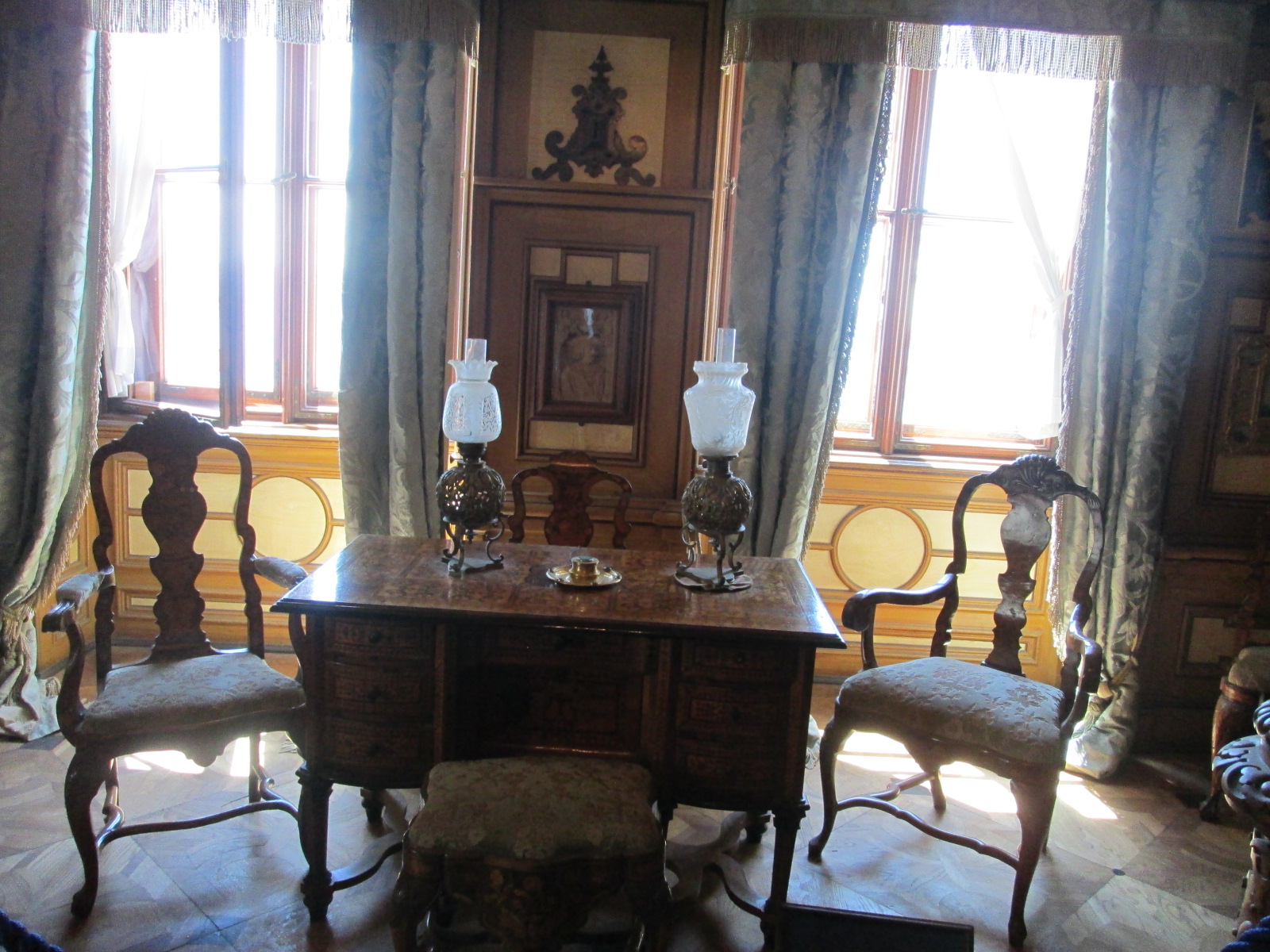
The interior showed the another aspect of this dynasty glory.

(The end of my summer trip to Slovenia 2016, thanks!)