Trieste is an Italian city bordered with Slovenia, and it has been a multicultural and disputed area among the three nations, Italy, Austria, and Slovenia. Most recently it was under control of Yugoslavia militant regime led by Titto just for 40 days at the end of WW2. It had been flourishing as an important Mediterranean seaport of the Austrian Habsburg Dynasty from 1382 until 1918 following WW1.
When I planned to visit Slovenia, I first examined the possible route to enter into it from Venice through Trieste as there is no direct flight connecting Japan with Slovenia. But finally I decided to drop in Trieste during the return trip to Japan. After hiking in the mountainous region of Kamnik and Bohinj, I thought it would be nice to see blue Mediterranean sea and that a train trip from Bohinj to Trieste would be also attractive.

Train trip from Bohinj to Trieste
On July 28 after enjoying 6 days’ hiking in Bohinj, I took a train early in the morning which departed Bohinjska Bistrica at 6:50 am for Sežana. The train ran through small and peaceful villages in the mountainous regions, stopping at every stations and crossing the bridge over the Soča River until reaching to Nova Gorica on the border with Italy, where I needed to wait for around one hour. The station was rather big, but a very quite with a few passengers occasionally seen walking on the platform like an old man accompanied by his dog or a bicyclist passing by while I was sitting on the bench.

 Villa Opicina's tram car
I got off the train at Sežana and tried to find a bus or taxi to go to Villa Opicina in Italian territory just located in the middle between Sežana and Trieste, but I spent more than one hour until catching a taxi, which carried me to the inn in Villa Opicina for less than 15 minutes. There was no boarder check on the entry into Italy, which made me realize the EU's freedom of movement of people. The place is located a little bit far from Trieste, but it is nice to ride on tram cars for going to and from Trieste.
 Castello di San Guito
The Castle stands on the hill of San Giusto, which was built in 1468 by Friedrich II of Habsburg on the remains of previous Venetian fortresses on the site and had been extended to strengthen its defense until 1636 under the Austrian rule. I started to walk from the last stop of the tram in Trieste and reached the top of the castle in an hour, which offered me a magnificent view of this seaport.


 Roman Theatre
At the foot of San Giusto Hill, the Roman Theatre was lying. But it took me almost one hour to find the way to access to it from the castle, as there were no signposts on the roads and nobody spoke English that I met on the street. This theatre was built between I and II century A.C. and accommodated around 6,000 spectators at the time, who could also enjoy magnificent sunsets during the performances as the sea was very close to the theatre.
Castello di Miramare
On the next day, I was determined to visit Miramare Castle. A friend of mine who was working in Italy had advised me to go there from the city center on cycling. So at first I was strolling along the seafront near the Piazza Unità d'Italia to try to find an rental-bicycle shop. But as I was watching the blue Adriatic Sea, I got a more splendid idea to approach the castle on a boat. I rushed in a tourist info center located near the square and got a time schedule for boats going to it.

Summer breeze made me feel fine on the deck under the sun, while I was watching white yachts sailing far out at sea and red roofed houses scattered on the green hills in the distance. The boat was gradually approaching the Miramare.


 Getting off the boat at the port, I lost my way to the castle although it stood very close to me. There were no signposts on the way and I asked several people how I could get there. They were all friendly but I could not understand their Italian. Finally I met an intelligent attractive lady who spoke fluently English and brought me back to the right direction. She was working for ICTP (The International Centre for Theoretical Physics) at Trieste, one of the Mecca for advanced study of physics, and knew many Japanese researcher. I was flattered by her remark that Japanese researchers were one of the best in the world.
Although the Miramare puts the castle on its name, but actually it looked like a villa for Emperor Maximilian I and his wife, Charlotte of Belgium. I was impressed among others by the beautifully arranged layout of gardens in contrast to sea, which reminded me of the hope and intelligence of the 19th century's Habsburg emperor.


The interior showed the another aspect of this dynasty glory.

(The end of my summer trip to Slovenia 2016, thanks!)
In Slovenia all the roads seem to lead to Ljubljana. So if you want to move from one place to another, you may probably find it easier to go to first to Ljubljana and then take a bus to your next destination. That's why I came here three times, but two of which were just for transit. I waited for a bus at Ljubljana when going to Bohinj from Kamnik as well as returning to the airport from Trieste. Excluding those transits, I made only one half-day tour around Ljubljana, an old capital of Slovenia while I was in the country. But it was a really precious moment for me, because I was so fortunate to be guided by two attractive young lady and gentleman.
Ljubljana Station
Our rendezvous was at the entrance of the Ljubljana station building where there was a clock. Getting off the train from Kamnik, I was quite upset as I could find no gate in the station to get out and had difficulty to find a way to the meeting place. The capital's station was very quite with so few station staff, which was quite a contrast to Tokyo's busy stations.
I met Maja and Žiga there for the first time, who had a special interest in Japanese culture and dedicated themselves to disseminate it among Slovenian through their Genki Center, the Japanese related center for education and culture. Maja was a founder, while Žiga was an expert on Japanese tea ceremony.

PREŠERNOV SQUARE
We walked toward the central square, Prešernov trg, which linked the new city with the Old Town. At the square I first noticed the statue of France Prešeren (1800–49) , a Slovenia’s great poet, looking gently toward a terracotta figure taking a peep from a window on the 2nd floor of the opposite side building (refer to the photos below) over the square. She is said to be his Beatrice named as Julija Primiča. On the northern side of the square, there stood the 17th-century salmon-pink Franciscan Church of the Annunciation.


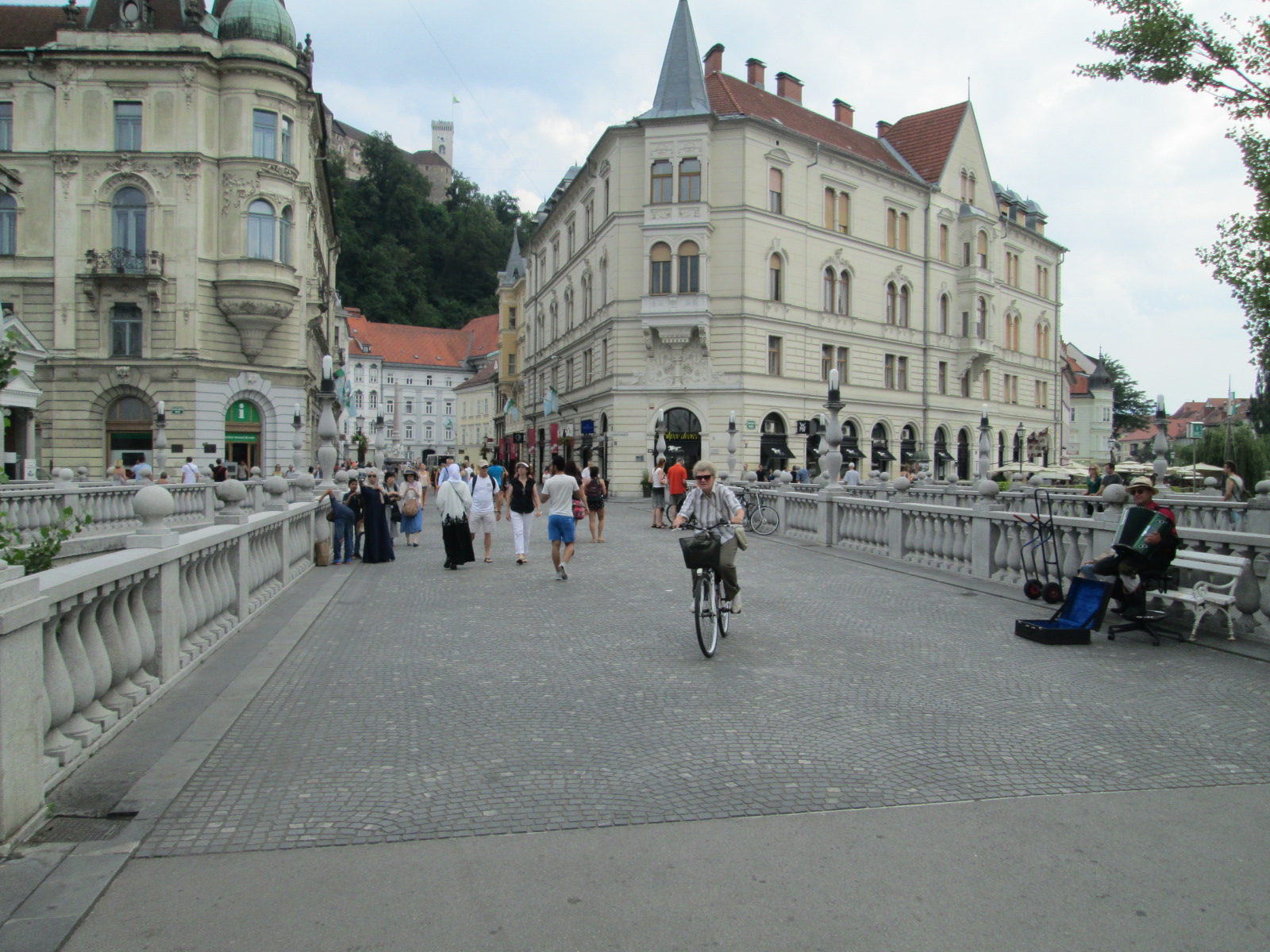
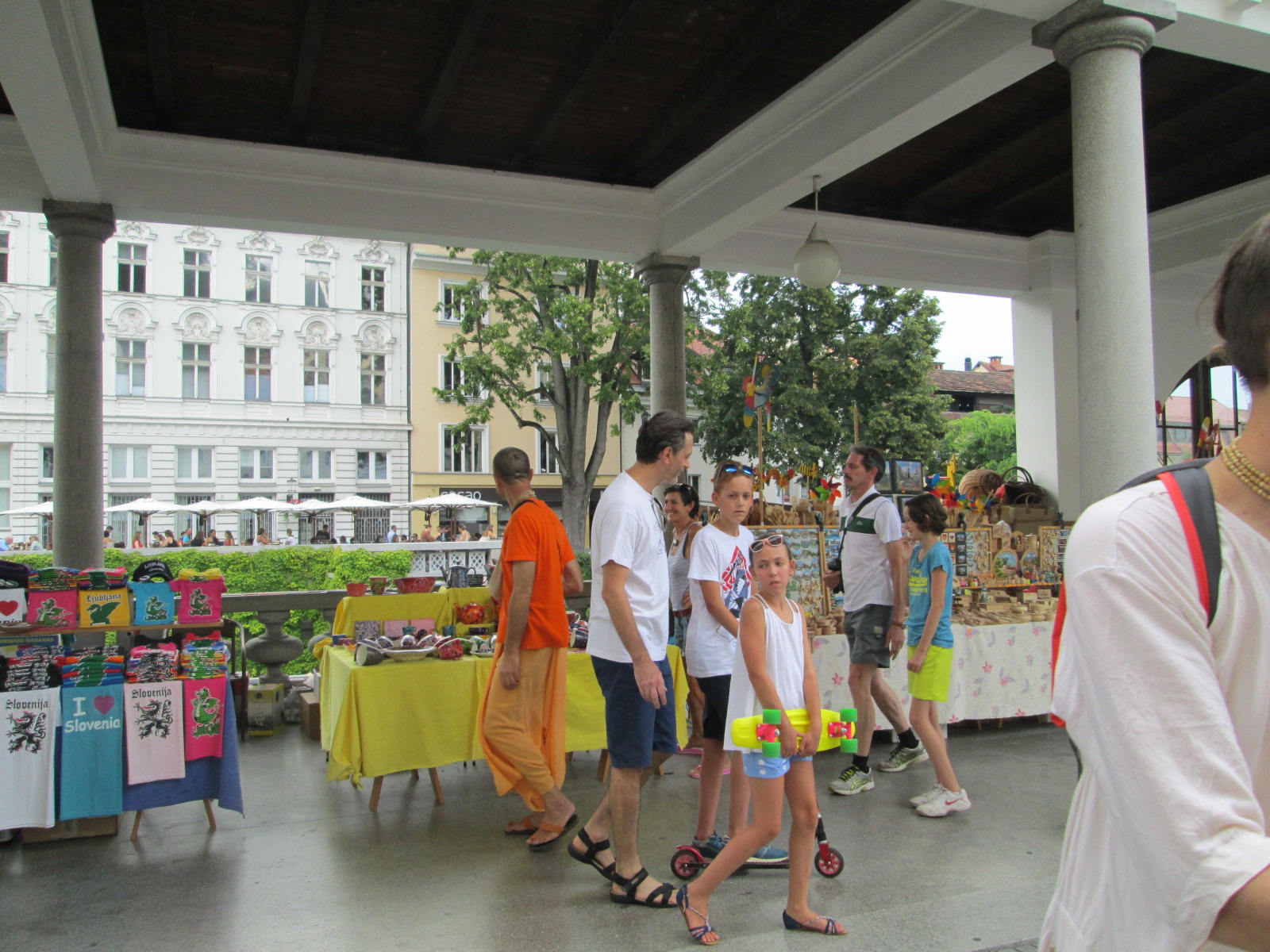
 Just south of the statue is the Triple Bridge (Tromostovje) which was built as a single connection in 1842 with the two sides added in 1931. We crossed over the Ljubljanica River to enter into the Old Town to explore the joyful open-air markets. There used to be a fisher market and butcher market around here.

 Ljubljana Castle
Then we rode up to the Ljubljana Castle by funicular.
This castle was constructed in the 15th century by the Hapsburg to defend against Turkish invasions, which were the most frequent in the 15th and 16th century. In 1809 Napoleon brought freedom and nationalism to the citizens of Ljubljana, which triggered the civil war with the Habsburg. After the French left, the Habsburg had used the castle for jails until the end of the Second World War. Until 1963, political opponents of Ljubljana had been confined in a cell of the castle. In the 1970s the renovation began and today the castle is a popular tourist site.
We entered the watchtower which was located on the southwestern side of the castle courtyard, and climbed to the top through a double wrought-iron staircase. Sweat beaded on my forehead, but the views from the top was worth an effort.


Wine Tasting
Back to the Funicular starting point on Krekov trg near the Ljubljana Puppet Theatre, we strolled along the Old Town streets and I felt some pleasant and romantic atmosphere at every corner that this town had to offer. They took me to "Sushi mama", a Japanese Susi-bar for dinner and we all enjoyed delicious Susi dishes together with Japanese sake. This was my first and last Japanese dishes to eat while I was traveling for two weeks in Europe. Next we moved on to the special beer shop "Zapopent.si", as they knew that I was brewing home beer and interested in different kinds of beer. Maja gave me a bottle of Brown Ale as souvenir, which I carried all the way back to Japan and tasted at home. Next we moved to the nearby Wine Bar& shop Movia for wine tasting.


Movia wine comes from the Movia estate in Goriška Brda, the borderland between Slovenia and Italy, 13 km to the northwest of Nova Gorica. The Goriška Brda is one of the most important wine-growing areas in Slovenia where they say that a combination of a Mediterranean climate and the vicinity of Alpine peaks creates the most preferable conditions for the production of dry wine. Although I don't know much about wine, but I can say that it was the best wine tasting ever in my life. We talked a lot over glasses of wine until midnight. I was impressed especially by the following remarks; the one was that Slovenian work so hard as much as they care about their family. I felt that this more balanced mindset was also important to the modernized Japanese society, which had been eroded excessively by technology and commercialism. And as just one month ago UK voted to leave EU on national referendum, I was interested in how they felt about Slovenia being a membership country of EU. What surprised me was this view that Slovenia had struggled to develop its unique strength in industries under the pressures from its neighboring powerhouses.
Beautiful old Ljubljana, delicious wine and pleasant talks, I had a very happy moment. Thanks so much!
(To be continued; the next is "Trieste" )
It’s a long way from Japan to Slovenia. That’s why Japanese tourists are rarely seen in Slovenia. Only a couple of package tours touche Slovenia as one of its destinations among multiple eastern Europe countries to visit, which inevitably include Lake Bled as a must-see landmark there. I’m rather inclined to avoid those popular tourist spots crowded with a lot of visitors from around the world. But lake Bled is special and furthermore it’s located only 30 km northeast from Lake Bohinj where I stayed in. I was curious to know what makes Lake Bohinj so attractive among tourists to Slovenia.
On a boat to the islet
On the 3rd day in Bohinj, July 25, I left the pension at 9 am to take a bus at Ukanc going to Ljubljana. Getting off at the Bled bus station, I first rushed in the tourist information to make a day plan for sightseeing around the lake. My priority was to go to see the church on the islet in the middle of the lake by a boat. On a clear Summer morning, the lake was calm and it was agreeable to see from a boat the iconic castle on the cliff rising 130 meters perpendicularly above the lake and the church on the islet gradually getting closer to us on the boat.


The church on the Islet
Around the landing place, there were some young bikini girls enjoying swimming or taking a nap under the sun. Unlike Bohinj lake of its twin lake, the water is said to be warm enough to be 26°C from June through August due to the hot springs near the lake. The lake was created when the Bohinj Glacier retreated after the last Ice age more than 20,000 years ago as well as the lake Bohinj,
 It has a great history. The name of Bled was first mentioned in history on April 10th, 1004 when the German Emperor Henry II donated Bled Castle and its lands to Albuin, the Bishop of Brixen in South Tyrol. The Brixen bishops and the Ljubljana Diocese from 1688 on had governed the area until the early 19th century when the Hapsburg took it over. The Church of the Assumption on the islet had been the pilgrimage church of the Mother of God on the Lake and frequented by medieval pilgrims. In the 19th to 20th century, with its beautiful lake and hot springs, the area became the finest health resort in the Austrian empire and attracted many European aristocrats.


The church has been here since the 9th century, which have been expanded and had many alterations with the Gothic style sanctuary consecrated in 1465 and the main Baroque altar carved in 1747. The wishing bell, a popular site for visitors, has been tolling on the island since 1534. Nowadays many young couples come to the church for their wedding and ring the bell for their happy future. The two small square portion of the floor under the bell string was transparent glass and pointed to the existence of an early Slavic cemetery dating back to the 7th century. While I was listening to the guide of the church, I wondered why they built a church on the island which were secluded by the lake water from the nearest villages where most people lived. It would be very troublesome for the inhabitants to come here to pray on every Sunday Mass. Back in Japan, as I wrote this blog, I found an interesting folk legend which says that Bled Island was formerly pastures and meadows where a chapel dedicated to the Virgin Mary stood on a low hill. I thought that this legend might give me a hint to my simple question.
Bled Castle
The boat was waiting for passengers for one hour at the landing place, on which I returned to the shore at 13:20 pm. After a late lunch, I headed for the castle, climbing up a steep path from the lake. Under the hot after-noon summer sunshine, it was almost a hiking with drops of sweat on my forehead. Most visitors seemed to come here by car or bus as there was a bus stop near the castle gate. But it was a nice walking and I could realize how it had been difficult to attack the castle in the medieval time.
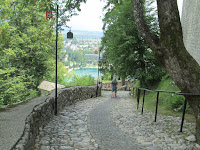

 Although the most structures of the existing castle were established in the 16th century, its history dates back to the early 11th century when Albuin, the Bishop of Brixen was granted the land. Their reign had lasted for 800 years since. There was also the museum which displayed the collection which traces the lake’s history from prehistoric era to the 19th century. I was very thirsty and could barely refresh myself with a cool beer on the terrace looking out over the lake.

The church on the Island looked graceful and romantic from the castle lookout and I understood why Bled has been attracting so many people since the medieval period who looked for peace of mind and relaxation.
(To be continued; the next is "Ljubljana" )