In Slovenia all the roads seem to lead to Ljubljana. So if you want to move from one place to another, you may probably find it easier to go to first to Ljubljana and then take a bus to your next destination. That's why I came here three times, but two of which were just for transit. I waited for a bus at Ljubljana when going to Bohinj from Kamnik as well as returning to the airport from Trieste. Excluding those transits, I made only one half-day tour around Ljubljana, an old capital of Slovenia while I was in the country. But it was a really precious moment for me, because I was so fortunate to be guided by two attractive young lady and gentleman.
Ljubljana Station
Our rendezvous was at the entrance of the Ljubljana station building where there was a clock. Getting off the train from Kamnik, I was quite upset as I could find no gate in the station to get out and had difficulty to find a way to the meeting place. The capital's station was very quite with so few station staff, which was quite a contrast to Tokyo's busy stations.
I met Maja and Žiga there for the first time, who had a special interest in Japanese culture and dedicated themselves to disseminate it among Slovenian through their Genki Center, the Japanese related center for education and culture. Maja was a founder, while Žiga was an expert on Japanese tea ceremony.

PREŠERNOV SQUARE
We walked toward the central square, Prešernov trg, which linked the new city with the Old Town. At the square I first noticed the statue of France Prešeren (1800–49) , a Slovenia’s great poet, looking gently toward a terracotta figure taking a peep from a window on the 2nd floor of the opposite side building (refer to the photos below) over the square. She is said to be his Beatrice named as Julija Primiča. On the northern side of the square, there stood the 17th-century salmon-pink Franciscan Church of the Annunciation.


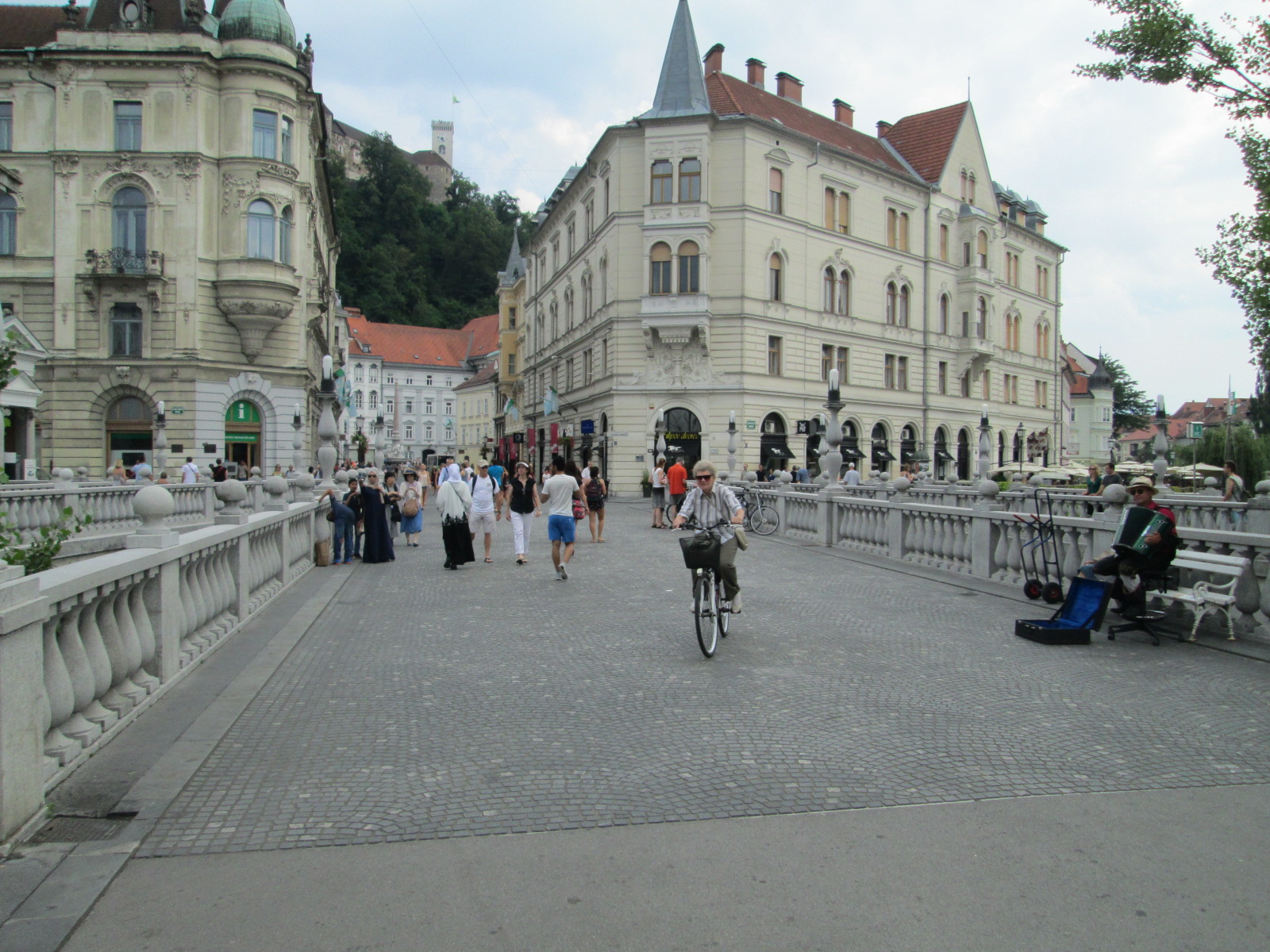
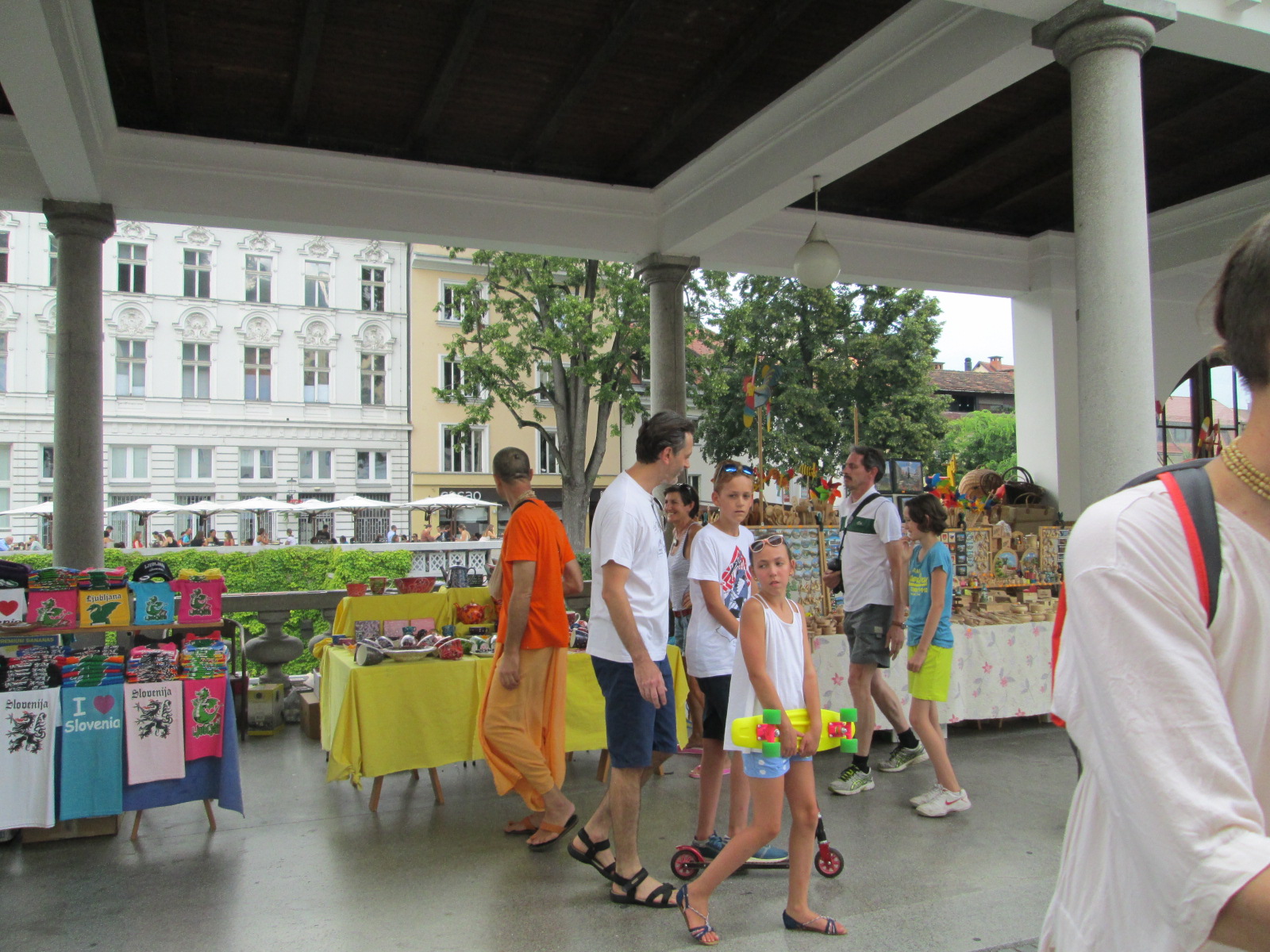
 Just south of the statue is the Triple Bridge (Tromostovje) which was built as a single connection in 1842 with the two sides added in 1931. We crossed over the Ljubljanica River to enter into the Old Town to explore the joyful open-air markets. There used to be a fisher market and butcher market around here.

 Ljubljana Castle
Then we rode up to the Ljubljana Castle by funicular.
This castle was constructed in the 15th century by the Hapsburg to defend against Turkish invasions, which were the most frequent in the 15th and 16th century. In 1809 Napoleon brought freedom and nationalism to the citizens of Ljubljana, which triggered the civil war with the Habsburg. After the French left, the Habsburg had used the castle for jails until the end of the Second World War. Until 1963, political opponents of Ljubljana had been confined in a cell of the castle. In the 1970s the renovation began and today the castle is a popular tourist site.
We entered the watchtower which was located on the southwestern side of the castle courtyard, and climbed to the top through a double wrought-iron staircase. Sweat beaded on my forehead, but the views from the top was worth an effort.
Ljubljana Castle
Then we rode up to the Ljubljana Castle by funicular.
This castle was constructed in the 15th century by the Hapsburg to defend against Turkish invasions, which were the most frequent in the 15th and 16th century. In 1809 Napoleon brought freedom and nationalism to the citizens of Ljubljana, which triggered the civil war with the Habsburg. After the French left, the Habsburg had used the castle for jails until the end of the Second World War. Until 1963, political opponents of Ljubljana had been confined in a cell of the castle. In the 1970s the renovation began and today the castle is a popular tourist site.
We entered the watchtower which was located on the southwestern side of the castle courtyard, and climbed to the top through a double wrought-iron staircase. Sweat beaded on my forehead, but the views from the top was worth an effort.


Wine Tasting
Back to the Funicular starting point on Krekov trg near the Ljubljana Puppet Theatre, we strolled along the Old Town streets and I felt some pleasant and romantic atmosphere at every corner that this town had to offer. They took me to "Sushi mama", a Japanese Susi-bar for dinner and we all enjoyed delicious Susi dishes together with Japanese sake. This was my first and last Japanese dishes to eat while I was traveling for two weeks in Europe. Next we moved on to the special beer shop "Zapopent.si", as they knew that I was brewing home beer and interested in different kinds of beer. Maja gave me a bottle of Brown Ale as souvenir, which I carried all the way back to Japan and tasted at home. Next we moved to the nearby Wine Bar& shop Movia for wine tasting.


Movia wine comes from the Movia estate in Goriška Brda, the borderland between Slovenia and Italy, 13 km to the northwest of Nova Gorica. The Goriška Brda is one of the most important wine-growing areas in Slovenia where they say that a combination of a Mediterranean climate and the vicinity of Alpine peaks creates the most preferable conditions for the production of dry wine. Although I don't know much about wine, but I can say that it was the best wine tasting ever in my life. We talked a lot over glasses of wine until midnight. I was impressed especially by the following remarks; the one was that Slovenian work so hard as much as they care about their family. I felt that this more balanced mindset was also important to the modernized Japanese society, which had been eroded excessively by technology and commercialism. And as just one month ago UK voted to leave EU on national referendum, I was interested in how they felt about Slovenia being a membership country of EU. What surprised me was this view that Slovenia had struggled to develop its unique strength in industries under the pressures from its neighboring powerhouses.
Beautiful old Ljubljana, delicious wine and pleasant talks, I had a very happy moment. Thanks so much!
(To be continued; the next is "Trieste" )
Updated on Sep. 24
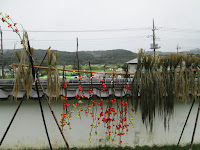
On Sep.22, a national holiday known as Autumnal Equinox Day in Japan, I went to Kinchakuda in Hidaka city together with my friends of high-school days, to see five millions of Lycoris radiata blooming along the Koma river. The red carpet of Lycoris was brightly shining in a drizzling rain after the seasonal typhoon No.16 hit the region.


 Hidaka city is located around 70 km northwest to the center of Tokyo. 1300 years ago the people from the current North Korea, then Koguryo, came to Japan as immigrants or refugees and gathered in 716 AC in then Koma county, a part of which is the current Hidaka city. The nearby Koma shrine worships a suspected member of the Koukuri royal family as a God.
After strolling around the Lycoris park, we visited an old farmer’s house which was built more than 100 years ago. The Arai family had been the head of the village for generations since the Edo era through Meiji era. The second floor of the house had been used to raise silkworms. Viewing the distant hill over the tile-roofed earthen wall in the garden, I realized Autumn coming at last.


An anecdote about Lycoris
One of my friends who is passionate about learning Korean culture, introduced us an anecdote about Lycoris radiata in her email on the next day. Let me cite her story. It describes well the nature of this flower and the mentality toward them which is shared among Japanese and Korean people;
"According to a local people, 'Now is the time to appreciate its beauty of flowers, but in December we will see the leaves growing thick all over the ground, which is also a spectacular view'.
In Japanese, Lycoris radiata is called as Higanbana (彼岸花) with an alias of “曼珠沙華“. In Korean it has also an alias of “相思華“, which is used as a word to represent autumn in Japanese Hike, a poem in seventeen syllables having a 5-7-5 syllabic form.
This “相思華“ is literally translated into “Leaves ponder over its flowers, and flowers ponder over its leaves”, meaning that with leaves and flowers both stemming from the same root, they will never meet each other.
She concluded in her email by saying that “We met several young couples there yesterday. I only wish they will find their happiness in future, with their love not ending sadly as Lycoris’s flower and leaf."
It’s a long way from Japan to Slovenia. That’s why Japanese tourists are rarely seen in Slovenia. Only a couple of package tours touche Slovenia as one of its destinations among multiple eastern Europe countries to visit, which inevitably include Lake Bled as a must-see landmark there. I’m rather inclined to avoid those popular tourist spots crowded with a lot of visitors from around the world. But lake Bled is special and furthermore it’s located only 30 km northeast from Lake Bohinj where I stayed in. I was curious to know what makes Lake Bohinj so attractive among tourists to Slovenia.
On a boat to the islet
On the 3rd day in Bohinj, July 25, I left the pension at 9 am to take a bus at Ukanc going to Ljubljana. Getting off at the Bled bus station, I first rushed in the tourist information to make a day plan for sightseeing around the lake. My priority was to go to see the church on the islet in the middle of the lake by a boat. On a clear Summer morning, the lake was calm and it was agreeable to see from a boat the iconic castle on the cliff rising 130 meters perpendicularly above the lake and the church on the islet gradually getting closer to us on the boat.


The church on the Islet
Around the landing place, there were some young bikini girls enjoying swimming or taking a nap under the sun. Unlike Bohinj lake of its twin lake, the water is said to be warm enough to be 26°C from June through August due to the hot springs near the lake. The lake was created when the Bohinj Glacier retreated after the last Ice age more than 20,000 years ago as well as the lake Bohinj,
 It has a great history. The name of Bled was first mentioned in history on April 10th, 1004 when the German Emperor Henry II donated Bled Castle and its lands to Albuin, the Bishop of Brixen in South Tyrol. The Brixen bishops and the Ljubljana Diocese from 1688 on had governed the area until the early 19th century when the Hapsburg took it over. The Church of the Assumption on the islet had been the pilgrimage church of the Mother of God on the Lake and frequented by medieval pilgrims. In the 19th to 20th century, with its beautiful lake and hot springs, the area became the finest health resort in the Austrian empire and attracted many European aristocrats.


The church has been here since the 9th century, which have been expanded and had many alterations with the Gothic style sanctuary consecrated in 1465 and the main Baroque altar carved in 1747. The wishing bell, a popular site for visitors, has been tolling on the island since 1534. Nowadays many young couples come to the church for their wedding and ring the bell for their happy future. The two small square portion of the floor under the bell string was transparent glass and pointed to the existence of an early Slavic cemetery dating back to the 7th century. While I was listening to the guide of the church, I wondered why they built a church on the island which were secluded by the lake water from the nearest villages where most people lived. It would be very troublesome for the inhabitants to come here to pray on every Sunday Mass. Back in Japan, as I wrote this blog, I found an interesting folk legend which says that Bled Island was formerly pastures and meadows where a chapel dedicated to the Virgin Mary stood on a low hill. I thought that this legend might give me a hint to my simple question.
Bled Castle
The boat was waiting for passengers for one hour at the landing place, on which I returned to the shore at 13:20 pm. After a late lunch, I headed for the castle, climbing up a steep path from the lake. Under the hot after-noon summer sunshine, it was almost a hiking with drops of sweat on my forehead. Most visitors seemed to come here by car or bus as there was a bus stop near the castle gate. But it was a nice walking and I could realize how it had been difficult to attack the castle in the medieval time.
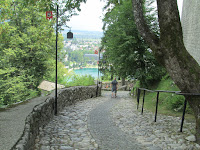

 Although the most structures of the existing castle were established in the 16th century, its history dates back to the early 11th century when Albuin, the Bishop of Brixen was granted the land. Their reign had lasted for 800 years since. There was also the museum which displayed the collection which traces the lake’s history from prehistoric era to the 19th century. I was very thirsty and could barely refresh myself with a cool beer on the terrace looking out over the lake.

The church on the Island looked graceful and romantic from the castle lookout and I understood why Bled has been attracting so many people since the medieval period who looked for peace of mind and relaxation.
(To be continued; the next is "Ljubljana" )
On the 5th day in Bohinj, July 27, I went out to the ranch early in the morning by taxi for joining a horse riding tour into meadows along the lake. There is a ranch called as “Mrcina Ranč” in the “Studor” village of Bohinj, just the opposite side of the lake from “Ukanc” where I stayed in. I reached there earlier than 8:00 am when the first tour of the day would start for which I had made a reservation last night.

There I met charming Patricia, who loved and had a considerable experiences with horse riding. Only she and I were the guest riders led by Anna, our instructor. It’s never gonna happen in Japan that I, a 66 years old senior guy, accompanied by young attractive ladies, could enjoy horse touring in the scenic paradise along the emerald-green lake.


“What a lucky day!”, I cried in my heart , but after that I began to worry about if I could get along well with a horse. I’ve never had experience with horse riding in Japan with my right hand completely numb due to the polio which I suffered from when I was 5 years old. I had experienced horse riding only two times in my life, one for three hours riding at the foot of the Canadian Rockies 8 years ago and the second one for just 30 minutes training by a professional coach in Hungary 5 years ago. With these two old memories, I wondered how well I could control a horse to follow Anna without delay. After practicing in the training ring, we got out into the village lane in a row with Anna leading and myself in the middle, guarded by Patricia in the rear.

There were very few people we met on the way, but sometimes village people called her from the porch to which Anna responded having a friendly chat with them. She knew everybody as she was born here. Even when we encountered a herd of cattle on the trail, they looked like knowing each other.
 We got to the lake. My horse was gentle to a beginner like me, but she was a gourmand. When she saw sweet weeds, she could not resist to eat them forgetting that she was carrying her important guest. It was troublesome for me to persuade her to go ahead again. Jože, an owner of the pension that I stayed at described horses in Bohinj as small, but strong for their size. According to the description by the ranch, their horses were the Icelandic which had been brought here by the Viking settlers in the mid-800 and bred with Scandinaian breeds. They are a different breed from the famous Lipizzan horses of Slovenia and said to be very social with "family life" in their blood. That may be why I had never been dropped off the saddle.


It was a really relaxed and fabulous horse riding tour. I’m sincerely grateful for their kindness. When we returned to the ranch, I asked Patricia's mother who was waiting there for us, to take a photo of us all with my camera. She carried a super Canon's camera and looked like a professional photographer.
Leaving the ranch, I walked down on village roads to the Church of St. John the Baptist near the west end of the lake in Stara Fužina. From there I took the route along the northern shore of Lake Bohinj back to Ukanc. This was also a nice walking trail with a beautiful view of the lake and the glacial U-shaped Upper Bohinj Valley.
(To be continued; the next is "Lake Bled" )