It’s a long way from Japan to Slovenia. That’s why Japanese tourists are rarely seen in Slovenia. Only a couple of package tours touche Slovenia as one of its destinations among multiple eastern Europe countries to visit, which inevitably include Lake Bled as a must-see landmark there. I’m rather inclined to avoid those popular tourist spots crowded with a lot of visitors from around the world. But lake Bled is special and furthermore it’s located only 30 km northeast from Lake Bohinj where I stayed in. I was curious to know what makes Lake Bohinj so attractive among tourists to Slovenia.
On a boat to the islet
On the 3rd day in Bohinj, July 25, I left the pension at 9 am to take a bus at Ukanc going to Ljubljana. Getting off at the Bled bus station, I first rushed in the tourist information to make a day plan for sightseeing around the lake. My priority was to go to see the church on the islet in the middle of the lake by a boat. On a clear Summer morning, the lake was calm and it was agreeable to see from a boat the iconic castle on the cliff rising 130 meters perpendicularly above the lake and the church on the islet gradually getting closer to us on the boat.


The church on the Islet
Around the landing place, there were some young bikini girls enjoying swimming or taking a nap under the sun. Unlike Bohinj lake of its twin lake, the water is said to be warm enough to be 26°C from June through August due to the hot springs near the lake. The lake was created when the Bohinj Glacier retreated after the last Ice age more than 20,000 years ago as well as the lake Bohinj,
 It has a great history. The name of Bled was first mentioned in history on April 10th, 1004 when the German Emperor Henry II donated Bled Castle and its lands to Albuin, the Bishop of Brixen in South Tyrol. The Brixen bishops and the Ljubljana Diocese from 1688 on had governed the area until the early 19th century when the Hapsburg took it over. The Church of the Assumption on the islet had been the pilgrimage church of the Mother of God on the Lake and frequented by medieval pilgrims. In the 19th to 20th century, with its beautiful lake and hot springs, the area became the finest health resort in the Austrian empire and attracted many European aristocrats.


The church has been here since the 9th century, which have been expanded and had many alterations with the Gothic style sanctuary consecrated in 1465 and the main Baroque altar carved in 1747. The wishing bell, a popular site for visitors, has been tolling on the island since 1534. Nowadays many young couples come to the church for their wedding and ring the bell for their happy future. The two small square portion of the floor under the bell string was transparent glass and pointed to the existence of an early Slavic cemetery dating back to the 7th century. While I was listening to the guide of the church, I wondered why they built a church on the island which were secluded by the lake water from the nearest villages where most people lived. It would be very troublesome for the inhabitants to come here to pray on every Sunday Mass. Back in Japan, as I wrote this blog, I found an interesting folk legend which says that Bled Island was formerly pastures and meadows where a chapel dedicated to the Virgin Mary stood on a low hill. I thought that this legend might give me a hint to my simple question.
Bled Castle
The boat was waiting for passengers for one hour at the landing place, on which I returned to the shore at 13:20 pm. After a late lunch, I headed for the castle, climbing up a steep path from the lake. Under the hot after-noon summer sunshine, it was almost a hiking with drops of sweat on my forehead. Most visitors seemed to come here by car or bus as there was a bus stop near the castle gate. But it was a nice walking and I could realize how it had been difficult to attack the castle in the medieval time.
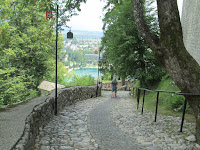

 Although the most structures of the existing castle were established in the 16th century, its history dates back to the early 11th century when Albuin, the Bishop of Brixen was granted the land. Their reign had lasted for 800 years since. There was also the museum which displayed the collection which traces the lake’s history from prehistoric era to the 19th century. I was very thirsty and could barely refresh myself with a cool beer on the terrace looking out over the lake.

The church on the Island looked graceful and romantic from the castle lookout and I understood why Bled has been attracting so many people since the medieval period who looked for peace of mind and relaxation.
(To be continued; the next is "Ljubljana" )
On the 5th day in Bohinj, July 27, I went out to the ranch early in the morning by taxi for joining a horse riding tour into meadows along the lake. There is a ranch called as “Mrcina Ranč” in the “Studor” village of Bohinj, just the opposite side of the lake from “Ukanc” where I stayed in. I reached there earlier than 8:00 am when the first tour of the day would start for which I had made a reservation last night.

There I met charming Patricia, who loved and had a considerable experiences with horse riding. Only she and I were the guest riders led by Anna, our instructor. It’s never gonna happen in Japan that I, a 66 years old senior guy, accompanied by young attractive ladies, could enjoy horse touring in the scenic paradise along the emerald-green lake.


“What a lucky day!”, I cried in my heart , but after that I began to worry about if I could get along well with a horse. I’ve never had experience with horse riding in Japan with my right hand completely numb due to the polio which I suffered from when I was 5 years old. I had experienced horse riding only two times in my life, one for three hours riding at the foot of the Canadian Rockies 8 years ago and the second one for just 30 minutes training by a professional coach in Hungary 5 years ago. With these two old memories, I wondered how well I could control a horse to follow Anna without delay. After practicing in the training ring, we got out into the village lane in a row with Anna leading and myself in the middle, guarded by Patricia in the rear.

There were very few people we met on the way, but sometimes village people called her from the porch to which Anna responded having a friendly chat with them. She knew everybody as she was born here. Even when we encountered a herd of cattle on the trail, they looked like knowing each other.
 We got to the lake. My horse was gentle to a beginner like me, but she was a gourmand. When she saw sweet weeds, she could not resist to eat them forgetting that she was carrying her important guest. It was troublesome for me to persuade her to go ahead again. Jože, an owner of the pension that I stayed at described horses in Bohinj as small, but strong for their size. According to the description by the ranch, their horses were the Icelandic which had been brought here by the Viking settlers in the mid-800 and bred with Scandinaian breeds. They are a different breed from the famous Lipizzan horses of Slovenia and said to be very social with "family life" in their blood. That may be why I had never been dropped off the saddle.


It was a really relaxed and fabulous horse riding tour. I’m sincerely grateful for their kindness. When we returned to the ranch, I asked Patricia's mother who was waiting there for us, to take a photo of us all with my camera. She carried a super Canon's camera and looked like a professional photographer.
Leaving the ranch, I walked down on village roads to the Church of St. John the Baptist near the west end of the lake in Stara Fužina. From there I took the route along the northern shore of Lake Bohinj back to Ukanc. This was also a nice walking trail with a beautiful view of the lake and the glacial U-shaped Upper Bohinj Valley.
(To be continued; the next is "Lake Bled" )
On the 3rd day in Bohinj, July 26, I went out to see the water fall named as “Slap Savica” in Slovenian, which was located within two hours walk from the pension. It was a nice easy morning promenade without using a bus, trains or cable car. I started at 9 am to follow the path in front of the pension, walking along the left bank of the Savica brook, which was the main permanent influx into Bohinj lake with its source at the waterfall.

Steep rocky wall & U-shaped valley
The trail gradually ascent under the the steep rocky slope of Mt. Pršivec (1,761 m), reaching to the entrance point to the waterfall where there was a tiny gift shop. I paid entrance fee at the gate and crossed the stone bridge over the brook. On the way up to the waterfall, I could recognize the U-shape valley over the lake basin between the mountains of Pri Vogel and Prsivec, which were carved by the glacier after the last glaciation about 20,000 years ago.

Savica Waterfall
The waterfall's water comes from Črno jezero lake at an altitude of 1319 m in the Seven Lakes Valley and bursts out through the rocky walls of Komarča, a cliff stretching from Mt. Prsivec. In the spring when the snow melts, the Savica waterfall has its glory and is described as a dragon that has hidden in the Komarča wall and rumbles fiercely to express its unstoppable rage. As I visited there in late July, the water was calmly running down the face of the rock instead of falling vertically as usually seen in Japan. The waterfall is 78 meters high with another smaller fall on its left tail of 25 m high. The color of the water was crystal green and very impressive.


In return I took the different broader road along the right bank of the Savica brook, which eventually brought me to the meadow land with a variety of wild flowers still blooming. I saw few hikers and only one pair of father and son enjoying cycling on the way to the lake in the forest. It was a really relaxing and comfortable walking under the summer sunshine.


Savica brook
The Savica brook finally flows into the lake at the Ukanc bridge near the pension that I stayed in. They said that people jumping into the lake to escape from the summer heat will soon get out of the water as it is too cold.

(To be continued; the next is "Horse riding along the lake in Bohinj )
On arrival at the pension, I asked Jože about his recommendations on the day trip hiking around Bohinj. Among his valuable suggestions, I chose the hiking trail to climb up to Mt. Sija (1880m) for my first day's excursion in Bohinj. As the Japanese proverb is saying that a foolish likes to go higher just as smoke do, I always like to be on a peak to enjoy a magnificent view of mountain ranges stretching in the distant.
Mt. Sija (1880m)
Next morning on July 24, I departed the pension at 9 am after breakfast and walked down to the lower cable car station. The hiking trail to Mt, Sija started from the upper cable car station with the altitude of around 1500m. It was quite comfortable for me to have an Alpine breeze cooling down my body under the summer sunshine while ascending along the ridge line.

<Alpine Flowers>
After taking a rest at the crossroads to Mt. Vogel, I continued to climb up slowly a steep rocky roof taking a glance carefully at lovely wild flowers that grew humbly between rocks. Bohinj and its surrounding mountains boast diverse flora with many indigenous plants and have attracted botanical experts around the worlds. I'm not an expert in this field, so I can not confirm, but the purple flowers on the photo below look like a Zois' Bellflower ( Campanula Zoysii), which has been present in this land since before the last ice age and is said to represent the Slovene. According to the Slovene government's web site of "Pearls of the floral wealth of Slovenia", it flowers in August high in the mountains in rock fissures. On lower meadows in Bohinj, I was overwhelmed by the beauty of colorful wild flowers blooming gregariously, but these small alpine flowers were so humbly gentle and encouraged me to keep going higher.


<360-degree view of the Julian Alps>
Shortly before noon, I stood on the peak of Mt. Sija, which offered me a magnificent 360-degree view of the Julian Alps in the Triglav National Park. The king of Mt. Triglav stood solemnly in the distance far behind me on the photo below with Mt. Vogel (1923m), an elder brother, sitting quietly next to Mt. Sija, which looked like inviting me to come closer. Oh the way up, I had seen so few climbers, but around lunch time hikers were gradually gathering at the peak. They were mostly young and came in a group or a couple from various neighboring countries like Poland, Germany or Italy. They all had happy faces and chatted with each other a little bit clamorously. Maybe I was only one in the sixties. A young polish whom I asked to take a photo of me was surprised to know that I've come all the way alone from Japan. After taking photos, I took lunch. The lunch package which they had prepared for me at the pension contained one apple, two Nectarines, one big sandwich and a bottle of water. I was so thirsty that I grabbed a nectarine first of all. It was so refreshing and sweet.


After about one hour of lunch rest, I gave up the idea to go further to Mt. Vogel and retraced my steps to the lake. Descending to the same crossroads I met the married couple with a daughter taking a rest. They came from Czechoslovakia for hiking and were heading to Vogel. They were very friendly and we had a nice chat. Their lovely daughter seemed to have a special interest in Japan as her boy friend in her high school had been staying in Tokyo as an exchange student. I asked him "if I would go to Czech for hiking, what mountain do you recommend me?". His answer was Šumava Mountain or Jeseníky and gave me his email address saying "Stay with us when you come". It's always the best way for getting a valuable information about the nature in foreign countries to ask its countryman who himself love hiking. I memorized those names in my note for planning the next summer's trip.

(To be continued; the next is "Slap Savica", the water fall in Bohinj )
The 1st day in Bohinj, Saturday July 23
The Julian Alps
Bohinj is an emerald-green mountain paradise lying in the heart of the Triglav National Park(TNP), one of the Europe’s largest protected natural area with towering Mt. Triglav (2864m), the highest in the country. The mountain ranges that stretch from northeastern Italy and reign over the TNP are called as the Julian Alps. There are approximately 150 mountains over 2000 m high in the Slovene Julian Alps with 25 of them over 2500 m high. They provide visitors with varieties of hiking trails ranging from an easy family hiking path along the lake shore to climbing to the nation’s symbolic Mt. Triglav which usually require two days of ascent with a mountain guide accompanied.
 Lake Bohinj
 is located 26km southwest of its glamorous twin sister of Lake Bled which is the most popular tourist spot in Slovenia. According to the description on a sign board on a hiking trail, Bohinj is an excellent example of a typical glacier landscape and its Glacier was the largest in Slovenia during the last glaciation about 20,000 years ago. Many traces of glacial erosion along with moraine dams and glacial erratic still remains here. It is directly connected by bus from Ljbljana in 2 hours. Leaving Kamnik, I was planning to get on the bus for Bohinj that would depart the Ljubljana bus station at 11:20am, but it was already fully booked before 11:00 am. So I waited for one hour and took the next bus, which was also crowded with many young wanderers coming from the various parts of Europe. But most of them got off at lake Bled. There were only two couples besides me who got off at the end stop of Bohinj Zlatorog in Ukanc village on the far west shore of the lake. It was a place for nature lovers who like camping, fishing, swimming or hiking.

5 nights stay in Ukanc village
At the Ukanc bus stop, Jože waited for me and took me to his pension by car where I was going to stay for 5 nights to enjoy hiking in the Julian Alps. His pension not only entertains guests at dinner on the comfortable open terrace with traditional Slovenian food and wine, but also provides hikers with the lunch package of sandwich, fruits, and drink at their requests. This was critical for a lonely senior traveler like me, which allowed me to explore the area anywhere and at any time without having to care about food.

(To be continued; the next is "Hiking in Bohinj" )


