Friday, August 12, 2016

Kamnik -Senior backpacker goes to Slovenia (2)

 On the next day, July 19, I flew to the Ljubljana airport from Warsaw and headed straight by taxi for the B&B in Kamnik, where I was scheduled to stay for 4 nights. This old town in the country side is conveniently located between the airport and the capital Ljubljana and also provides a good access to the Kamnik-Savinja Alps. 

<a medieval town of Kamnik> After tidying my travelling bags, I started to explore the town looking for a nice restaurant to take a dinner before dusk. As I was walking down a backstreet and turning at the corner, I casually looked up to find a lot of colorful umbrellas floating like balloons in the sky over the deserted main street.


 I have not yet fully recovered from jet lag and felt a little bit sleepy, so it was as if I were suddenly thrown away into the Middle Ages when it was flourishing as a trading town on the road between Ljubljana and Celje. Looking ahead I saw a two-story Romanesque chapel standing on Mali Grad hill which used to be a part of the castle complex built in the 11th century.  Although the chapel of St. Eligius had Gothic and Baroque alterations in later stages, it still preserved its original Romanesque color.


 From the hill top, I had a splendid view of the town with rich history along with the mountain ranges of Kamnik-Savinja Alps in the distance.      


<Velika Planina>
 Next day I visited Velika Planina which was located about 11 km northeast of Kamnik and could be easily accessed from Kamnik by using bus and the cable car. This herdsmen settlement comprises 63 huts scattered over the pasture plateau with the altitude of around 1600 m. Those huts still form a community with the so-called Parliament, the dance floor, the chapel and the museum. Early in June, herdsmen come to Velika planina with about 380 head of cattle from the nearby villages and spend 3 to 4 months here for cattle pasturing.  


 I entered into one of the huts called as "Preskar Hut Museum", where visitors could learn the herdsmen's life in 19th century. According to the description of a young man in this hut, the first settlers came here at the time of Maria Theresia, around 300 years ago. Herdsmen used to live alone in his hut during the summer away from his family, which means most of them were senior who did not need to take care of his family. They made everything necessary for their own living by themselves including a specific type of hard cheese decorated with special carved pattern using by wooden sticks. 


There I also found the hut which served visitors their traditional meal of a sour milk and corn mush shown on the photo below on the left side. The photo below on the right side shows a cheese produced here by an old woman, which I bought as a souvenir. She put a slip in the package for a cheese, on which some lyrics is written in Slovenian, but I can't remember now what it is all about.      


<Kamnik Alps>

 On the 3rd day in Kamnik, I went hiking to the Kamniki-Savinja Alps. The hiking trail starts from the end stop of the bus route, a few stops ahead of the lower cable car station to Velika. Local people called this end bus stop as the source of Kamniska Bistrica, where "Bistrica" meant a clear river in Slovenia. I got off the bus at around 10 am and moved by the perfectly clear water which was drinkable as in Japanese mountains.


  There are several peaks exceeding 2,500 m in Kamnik Alps with Grintavec (2,558 m) as the highest among them. Considering my age of 66 years and the bus schedule, I chose heading for Kamnisko Sedlo (1,884 m), situated at the saddle point between Planjava (2,394 m) and Brana (2,253 m). The estimated walking time to Sedlo was 3h45m with a steep elevation of more than 1000 m from the mountain lodge (601 m).  The hiking trail was well marked, but I missed the mark to take the wrong direction above the stone house of the cargo lift and lost one hour. The young hiker whom I met on the way said he had also missed the trail at the same point in the early morning. So it might be a single point that could possibly make hikers confused. But I gave up climbing finally at 14 pm because of my physical exhaustion and the last bus schedule. I regretted not to have started climbing earlier. In the summer time when the temperature is so high, I should have started at least 7 am. Furthermore I am not what I used to be.               


<Kamnik Train station>
 One of the reasons why I chose to stay in Kamnik for the first 4 days in Slovenia was its vicinity to the capital Ljubljana. Not only by bus or taxi, but also trains frequently run everyday except on weekends. On the 4th day in Kamnik, I went to Ljubljana by train after washing my dirty cloths. Surprisingly there were three train stations in this small town, but the two of which were not staffed. It's nice to be able to get on a train at the nearest station. It took only 45 minutes to arrive at Ljubljana from Kamnik by train.   


 Next morning on July 23, I left Kamnik for Bohinj, my next destination for hiking in Slovenia. In Kamnik, I had been staying at Pod Skalo, the family-run B&B, which was conveniently located within the walking distance from the center of the town, the train station and the bus stop. I felt comfortable and relaxed during my 5 days stay just like I was at home. Many thanks for your warm hospitality, Vesna and Blaz!


(To be continued; the next is Bohinj or Ljubljana)

Saturday, August 6, 2016

Warsaw -Senior backpacker goes to Slovenia (1)

 Last summer I was on a top of some peak in the Glossglockner national park, looking toward distant mountain ranges stretching to the east. That’s why I decided to come to Slovenia for this summer. So far Moscow has been the gate-way for me to travel to Europe from Japan just because I could not endure the long flight of more than 10 hours. But fortunately this year the LOT Polish airline launched a new direct line between Warsaw and Tokyo (Narita) this February, which allured me to try this airline to add also Warsaw to one of my destinations for 2016 summer. 


 I made a reservation for two nights in total at an old hotel in front of the Old Town Market Square, one night on July 18 before going to Slovenia and the other on July 30 before returning to Japan. The plane arrived at the Frederic Chopin Airport around 14 pm, so I had a time to stroll around the square with the Royal Castle and St John’s Cathedral before dusk and was surprised to find that this area gave really a medieval-like atmosphere as if they had been there for centuries although it was completely devastated during the WWⅡ. 


 On the way back to the hotel, I noticed a standing signboard along the backside street of the Cathedral, indicating the opening of Chopin piano concert at 18:00 played by one of young eminent Polish pianists. At first I hesitated to enter into the hall because I was not well dressed for attending at a high-class concert with a rough summer shirt in sandals. But I was so enchanted by a lady at the front who explained me about the today's event in a splendidly elegant manner and made me decide to be in. This was a salon-like concert with at most 30 seats in a cozy room and wine served during an intermission. Anyway I like Chopin as my wife is teaching piano at home.


After the concert, I learned that she was also one of the renowned Chopin pianists in Poland, so I bought her CD for my memory in Warsaw. Her name was Katarzyna Kraszewska and gave me her autograph. I regret that I could not come again tomorrow to listen to her Chopin due to my departure for Slovenia.


 In the music hall I happened to have a chat with a young French man. As we talked during an intermission over a glass of wine, I knew that his mother was a pianist and his father very recently had been appointed as a professor of physics at Tohoku University in Japan. He himself had been travelling in Hokkaido, the northern part of Japan one month ago. After the concert we took a dinner together near the old town market square and talked over Japan and EU in which I had a special interest after the UK voting to leave EU. It was a really pleasant and enlightening conversation for me as he was a lawyer working for EU. 

 Only one night in Warsaw, but it gave me a pleasure to meet talented people and learn their unique personality. Warsaw was more than expected!

(to be continued; the next is "Kamnik" in Slovenia)          


Saturday, July 9, 2016

Home brewing beer with a side dish of Edamame, salt-boiled green soybeans for summer time in Japan

 May and October are the best months for brewing beer at home.
It’s not too hot nor too cold. Mild and stable weather makes us easily ferment the malt extract at home without any special equipment to control temperature.
  In early May, I brewed Belgian Abbey beer with alcoholic concentration of 8%, dark brown, full-bodied with a malty flavour. It requires long maturation of two months in total including fermentation process. 


 Earlier than beer brewing, in the middle of April, I sowed seed with green soybeans on the allotment which I borrowed from Yoshikawa-city, 45 minutes away from my home by car. Early seeding of soy-beans makes it possible for me to grow them without using agrochemicals.    


 Now is the time to start drinking my self-made craft beer with salt-boiled Edamame, which is one of the best partners with beer in Japanese summer time. I don’t want to leave for Slovenia next week before tasting them. 
It’ nice to have genuine organic food made at home!


Monday, January 11, 2016

Green energy in Austria vs Japan

Wind turbines near Vienna
 Landing on the Vienna airport at midnight, I spent more than an hour to find a nearby accommodation because of a system failure of the hotel for which I made a reservation online in Tokyo before departure. Next morning while taking a walk after breakfast, I was a little bit surprised to see a bunch of wind turbines spinning gently in a line on green fields at the backyard of this unknown hotel. I used to think that wind turbines do not match with natural landscape and are ugly. But the scenes were not so bad, or rather they were harmonized into green fields. The hotel was located just 15 km north to the airport.


On the way to Salzburg
 Through a window on a train for Salzburg from Vienna, I noticed in the distance a lineup of wind turbines extended to west on green fields and also frequently saw solar panels on rooftops along the railway. Travelling to country sides, from Salzburg to Zell Am See, from Zell to Lienz on trains or buses, and even at the summit stations of lifts in mountains with an altitude of 2000m, I came up with solar panels on roof-tops and wind turbines. I felt that this country, Austria, has a kind of passion toward renewable energy. 


   Austria vs Japan in energy usage
 Japan has turned unwillingly back to fossil fuels since March 2011 when the Great East Japan Earthquake with Tsunami killed not only the nearly 20K people, but also damaged the Fukusima Daiichi Nuclear Power Plant. This damage has caused all nuclear power plants in Japan (48 plants across 17 regions with the total capacity of around 44 GW as-of 2014 Dec.) to suspend its operation until the recent modest attempts to reopen a few of them, which were confirmed on its safety operation by the Japan Nuclear Regulation Authority.
This means that Japan has currently no way to reduce the carbon-dioxide emission, giving up its commitment to Kyoto protocol of COP3 in 1997 to prevent the global warming from escalating further.

 According to the International Energy Agency (IEA) statistics, Japan produced more than 26% CO2 per capita in 2013 compared with Austria during the same year. Based on the same IEA data, I found these differences came from the use of different energy resources that each country had to generate electricity and heat. Let me illustrate this situation as below;

“Share of total primary energy supply in 2013” 
                                       Austria           Japan          note 
Fossil Fuels    :               67%               95%            coal, oil, natural gas
Nuclear           :                 0%                 1%
Renewables    :               33%                 5%
   (Hydro)                         (11%)              (2%) 
   (Geo/Solar/Wind):        ( 2%)               (1%)
   (Biofuels/Waste):         (20%)              (3%)

 It's clear that Japan rely heavily on fossil fuels with 95% of the total share, while Austria uses more than 6 times of renewables with notably dependence on hydropower and biofuels/waste. Although Japan has constructed so far many huge hydroelectric power plants spending a lot of money, but they seems to simply store water for the time of emergency in energy supply and not be used effectively for providing constantly power supply. The worst thing is that those construction were often done in sacrifice of natural environment. The most recent ongoing project is the controversial Yatsuba Dam, which was planned to be operated in 2020 with the investment budget of nearly 40 billion USD and eventually will force all village people to evacuate from their ancestral homes. I don't know the exact ratio, but it seems that Austria generates electricity from water in a different way from Japan with Austria using effectively more of smaller facilities such as pumped-storage hydroelectric power stations so that they can preserve the surrounding natural environment and not force people to evacuate from their home land. 


At B&B in Zell Am See 
 In Zell Am See, I based on the Hubertus, a family-run B&B, to go on a hiking in the nearby mountains on the Hohe Tauern National park. In my planning to the hiking trip to Austria while I was in Japan, I picked up this accommodation from the Lonely Planet Guide because of its passion for environmental protection. I had spent memorable four days at a cozy room surrounded with wooden furniture in the house equipped with solar panels.


 The pension was awarded the Austrian environmental seal of approval for achieving considerable amount of CO2 saving. The secrets of its success, as it seemed to me, were summarized as in the following basics;
  • Save energy 
  • Purchase of green energy instead of fossil fuel energy
  • Harness the eco-friendly power generators 
 Regarding "Save energy" policy, for examples, there was no fridge in my room, but guests could share the one at the hall on the 1st floor, which was good for me to have a chat with other guests. And I totally agreed with dimming room lights to take more starry lights from heaven through windows. I changed my mind about driving a rent-a-car to Kaiser-Franz-Joseph-Höhe through the famous Grossglockner High Alpine Road, but took part in the bus package tour, because I sympathized with the idea that visitors should also be a part of protecting the country's natural environment by choosing a vehicle capable of carrying 50 people with less CO2 emissions than 50 cars for 50 people. I think that those are the spirits of saving energy.   


At the summit lookout to the magnificent snow-capped Grossglockner, the highest in Austria, I realized that the glacier has been actually retreating for centuries to reveal its rustic scar due to the global warming, which made me sad. 
People here are trying hard to protect its natural fauna by restricting, for example, the car traffic on Alpine high road, while promoting its natural assets for business purposes. I thought that we should care more about our natural environment and make a effort to leave more of its assets to our children. 
 Smaller efforts with renewables by individuals, but in aggregate those efforts would be proved to be more effective in energy usage and safer in preservation of natural environment than the construction of giant Nuclear reactors or huge Hydroelectric power plants,  

  Japan will see the liberalization of retail electricity in April, 2016. I hope that this will lead to more effective usage of energy, thus reducing the greenhouse gas emissions in Japan as well as on our planet,

Thursday, November 5, 2015

Kals - A senior hiker on Austrian Alps (4)

  A photo of an old small church standing on a green field in a remote and isolated village between mountains, caught my eyes when I was planning a hike trip in Austria. That was St. Georg church of Kals, which made me reserve the 3rd day in Lienz for visiting it.


Kals am Großglockner 
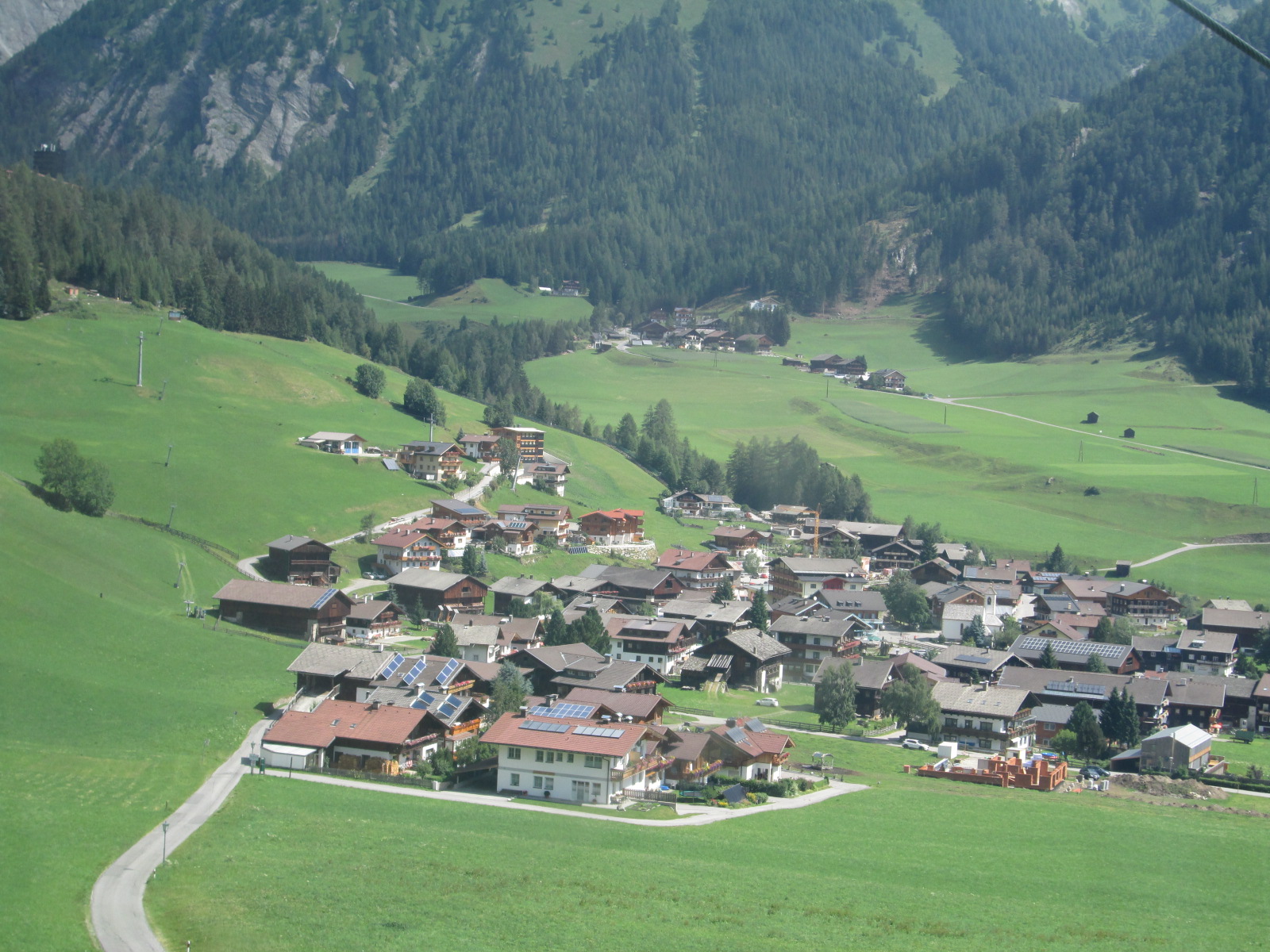
 Kals is a small village at the foot of the Großglockner mountain (3,798 m) in East Tyrol with a population of about 1,200 in 2015, which lies approximately 30 km north-northwest of Lienz. On July 20, I got on a bus 4408 at 9:05am in front of Lienz train station to visit this village. The bus ran north along the river Isel for nearly 30 minutes to Huben, where I changed to another bus for Kals village. Within an hour in total, I got off at the information center in Ködnitz district of Kals and planed the hiking course for that day with the help of a young lady staff there.  


St. Georg church
 I made up my mind to climb to Mt. Gorner (2,702 m) and headed for the lift station in Grossdorf, On the way, I found a small Romanesque church of St Georg standing in solitude on a green field. According to the old charters, this village had already a separate parish in 1197 and the St Georg church is said to have been rededicated in 1366. 


 This church looked like symbolizing the village’s unique history. During the latter Iron Age the Celts came in and founded its kingdom Noricum in 400 BC, which became a province of the Roman Empire in 16 BC. After the battle of Aguntum 610 between Bavarians and Slavs, the Slavs penetrated into the valleys of East Tyrol and settled in the Kals Valley. Historically there lived together peacefully Celts, Romans, Slavs and Bavarians for centuries, developing a spirit of community through faith in God in this isolated village. I imagined how they could have forgotten their hatred in everyday life and pray for God side-by-side at this Romanesque church. 

Mt. Gorner
 There are several pleasant hiking routes along the 19.5 km long Kals Valley, but I preferred to be on a top of mountains, even if it was not the mighty Grossglockner. The lift station in Grossdorf, just 10 minutes walking away from the church, was an entrance to the high alpine hiking trails such as the ascent to Mt. Gorner (2702m) or Europa Panoramaweg which leads to Matrei im Osttirol village. From the summit station I took the route to  Mt. Gorner.

<Kals village>                       <Mt. Grossglockner>
     

 Ascending a steep rocky slope starting from Adler Lounge at the summit station, I enjoyed 360 degree spectacular views before my eyes. Yes, this is the Hohe Tauern National park with more than 60 peaks over 3000 meters viewed from this trail. Near the top of Mt. Gorner, I met a Belgium family with two small kids and asked him to take a photo of me with the Mighty Grossglockner, the highest in Austria in the back. 


 From the peak, I returned to the Adler Lounge, where I took a late lunch with a little bit of beer watching magnificent mountain ranges.  
Here were my orders;
 - Weihenstephaner Weizen hall 0.3l for 3.00 euro
 - Grösser Bier Ladypfiff 0.2l for 2.4 euro
 - Würstl mit Brot und Senf for 4.00 euro
This was absolutely one of my best restaurants ever. 


 While waiting for a last bus to Lienz at Ködnitz, I met a senior couple from UK, who were travelling across Europe by car. As their sun was working in Osaka, Japan and they had once traveled across my country, they were very friendly and we spent a pleasant time chatting for a while. And they taught me an interesting beverage dubbed as "Radler" with beer and lemonade which was the ideal for mountain hikers who loved beer, but couldn't drink while walking. Next time I'd try that certainly!


 (to be continued; next "Renewable energy in Austria vs Japan") 

Related blogs are;
"Mt. Schafberg - A senior hiker on Austrian Alps (1)" posted on Aug. 4, 2015 
"Zell Am See - A senior hiker on Austrian Alps (2)" posted on Sep. 9, 2015
"Lienz - A senior hiker on Austrian Alps (3)" posted on Oct. 22, 2015